Also called (Norwegian names)kysttorskfjordtorsktaretorskskreiSourceFact from a specialist source · Applies to all regions1EncyclopediaStore norske leksikontorskAll sources on this page
Coastal cod are more or less resident, and all along the coast there is local cod that does not migrate.SourceFact from a specialist source · Applies to all regions1EncyclopediaStore norske leksikontorskAll sources on this page
Northern Norway: common. About 75 per cent of the coastal cod north of Stad are found north of 67°N, and the skrei spawns in Lofoten and Vesterålen.SourcesFact from a specialist source · Applies to all regions4ResearchHavforskningsinstituttetKysttorsk – nord for 62ºN5ResearchHavforskningsinstituttetTorsk – nordaustarktisk (skrei)All sources on this page
Found in
Bottom and open water
Best season
Oct–Dec
Methods
Pilk fishing from a boat, Large shad for big cod, Lures and jigs from shore, Trolling
Rules checked
29 September 2026
Getting started
Your first try for Atlantic cod
One recommended starting point: pilk fishing from a boat from a boat. More methods are listed under “How to fish”.
3. Rig up: pilk (heavy metal jig) with rubber worms
1Main line. Braided line (multifilament) from the reel.SourceTackle advice from a source of experience · Applies to all regions8ExperienceNormark Norway (elbe.no)Sjøfiske fra båtAll sources on this page
2Swivel. Connects the main line and the leader.SourceTackle advice from a source of experience · Applies to all regions8ExperienceNormark Norway (elbe.no)Sjøfiske fra båtAll sources on this page
3Leader. A length of strong monofilament between the main line and the pilk. It withstands teeth and bottom contact better than braided line.SourcesTackle advice from a source of experience · Applies to all regions8ExperienceNormark Norway (elbe.no)Sjøfiske fra båt12OrganisationNorges Jeger- og FiskerforbundSlik får du fisk i saltvannAll sources on this page
4Rubber worm. A hook with a rubber worm, hanging as a dropper on the leader.SourcesTackle advice from a source of experience · Applies to all regions8ExperienceNormark Norway (elbe.no)Sjøfiske fra båt11ExperienceSeilmagasinetSlik fanger du juletorskenAll sources on this page
→Attach the swivel to the main line, and tie the leader to the swivel.SourceTackle advice from a source of experience · Applies to all regions8ExperienceNormark Norway (elbe.no)Sjøfiske fra båtAll sources on this page
→Tie one or two rubber worms onto the leader. Once you have found the fish, 1–2 metres between the hooks is enough.SourcesTackle advice from a source of experience · Applies to all regions8ExperienceNormark Norway (elbe.no)Sjøfiske fra båt11ExperienceSeilmagasinetSlik fanger du juletorskenAll sources on this page
→Attach the pilk at the bottom, preferably with a strong swivel so it is easy to change.SourceTackle advice from a source of experience · Applies to all regions8ExperienceNormark Norway (elbe.no)Sjøfiske fra båtAll sources on this page
→The leader should be long enough that the next fish is still in the water when you hold the first one in the boat.SourceTackle advice from a source of experience · Applies to all regions8ExperienceNormark Norway (elbe.no)Sjøfiske fra båtAll sources on this page
A length of heavier line between the main line and the bait, which withstands wear better.SourcesTackle advice from a source of experience · Applies to all regions8ExperienceNormark Norway (elbe.no)Sjøfiske fra båt12OrganisationNorges Jeger- og FiskerforbundSlik får du fisk i saltvannAll sources on this page
About 75 per cent of the coastal cod north of Stad are found north of 67°N, and the skrei spawns in Lofoten and Vesterålen.SourcesFact from a specialist source · Applies to all regions4ResearchHavforskningsinstituttetKysttorsk – nord for 62ºN5ResearchHavforskningsinstituttetTorsk – nordaustarktisk (skrei)All sources on this page
→Note the depth where the fish bites, using coloured line or a line counter on the reel, and you will quickly get back to the right depth.SourcesFishing tip confirmed by 3 independent sources of experience · Applies to all regions8ExperienceNormark Norway (elbe.no)Sjøfiske fra båt10ExperienceHooked.noNå er det tid for stortorsken!11ExperienceSeilmagasinetSlik fanger du juletorskenAll sources on this page
→If you are after the biggest cod, a large soft-plastic shad is a good choice. Work it with calm movements in the water layer where the fish are, so that it swims like a baitfish instead of being pilked hard.SourcesFishing tip confirmed by 3 independent sources of experience · Applies to all regions7Experienceasgeiralvestad.noSlik fisker du torsk, tips og triks8ExperienceNormark Norway (elbe.no)Sjøfiske fra båt11ExperienceSeilmagasinetSlik fanger du juletorskenAll sources on this page
→When the cod move into shallow water, it can pay to troll along the shore and over shallow areas. Keep the lure near the bottom.SourcesFishing tip confirmed by 3 independent sources of experience · Applies to all regions7Experienceasgeiralvestad.noSlik fisker du torsk, tips og triks8ExperienceNormark Norway (elbe.no)Sjøfiske fra båt11ExperienceSeilmagasinetSlik fanger du juletorskenAll sources on this page
Bait
→Oily fish such as mackerel and herring make good bait.SourcesFishing tip confirmed by 3 independent sources of experience · Applies to all regions7Experienceasgeiralvestad.noSlik fisker du torsk, tips og triks8ExperienceNormark Norway (elbe.no)Sjøfiske fra båt9OrganisationNorges Jeger- og FiskerforbundTorskAll sources on this page
→If nothing happens, change spot. Knowing when to move often matters more than what you have on the hook.SourcesFishing tip confirmed by 3 independent sources of experience · Applies to all regions9OrganisationNorges Jeger- og FiskerforbundTorsk10ExperienceHooked.noNå er det tid for stortorsken!11ExperienceSeilmagasinetSlik fanger du juletorskenAll sources on this page
→Northern NorwayThe skrei comes in to the coast to spawn in March–April. The most important spawning grounds are in Vesterålen and Lofoten.SourceFact from a specialist source · Applies to: Northern Norway5ResearchHavforskningsinstituttetTorsk – nordaustarktisk (skrei)All sources on this page
Rules
Minimum sizes and closed seasons
Show rules for
Showing rules for the whole coast. Rules that apply to only part of the coast are labelled.Showing rules for Southern and Eastern Norway (Østfold to Agder (the Skagerrak coast)).Showing rules for Western Norway (Rogaland and Vestland, south of Stad).Showing rules for Central Norway (Møre og Romsdal and Trøndelag).Showing rules for Northern Norway (Nordland, Troms and Finnmark).
→South of StadMinimum size south of 62°N (Stad): 40 cm.SourceRule from the authorities · Applies to: South of Stad16AuthorityFiskeridirektoratetMinstemål i fritidsfiskeAll sources on this page
→North of StadMinimum size north of 62°N (Stad): 55 cm within 4 nautical miles of the baselines, 44 cm outside.SourceRule from the authorities · Applies to: North of Stad16AuthorityFiskeridirektoratetMinstemål i fritidsfiskeAll sources on this page
→Western Norway, Central Norway, Northern NorwayThe Directorate of Fisheries’ overview of protected and partially protected species lists no closed season for cod other than in the Oslofjord and the spawning areas along the Skagerrak coast.SourceRule from the authorities · Applies to: Western Norway, Central Norway, Northern Norway18AuthorityFiskeridirektoratetFreda og delvis freda artarAll sources on this page
→If you catch a fish under the minimum size, wet your hands, release the fish carefully and let it go. If the fish is dead or not viable, you may keep it.SourceRule from the authorities · Applies to all regions16AuthorityFiskeridirektoratetMinstemål i fritidsfiskeAll sources on this page
→It is prohibited to fish closer than 100 metres to fish farms.SourceRule from the authorities · Applies to all regions21AuthorityFiskeridirektoratetGenerelle reglarAll sources on this page
→It is not permitted to use live fish or other live animals as bait.SourceRule from the authorities · Applies to all regions21AuthorityFiskeridirektoratetGenerelle reglarAll sources on this page
→Northern NorwaySeparate local restrictions may apply, for example for the cod fishery in Lofoten.SourceRule from the authorities · Applies to: Northern Norway21AuthorityFiskeridirektoratetGenerelle reglarAll sources on this page
The rules are translated from Norwegian. Only the Norwegian text and the authorities’ own pages (in Norwegian) are authoritative. Check them before your trip.
Not checked: rules in national parks and other protected areas at sea and local rules adopted by the municipality. The regulations may change, so always check the current rules before your trip.
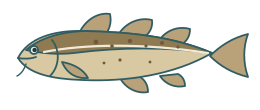
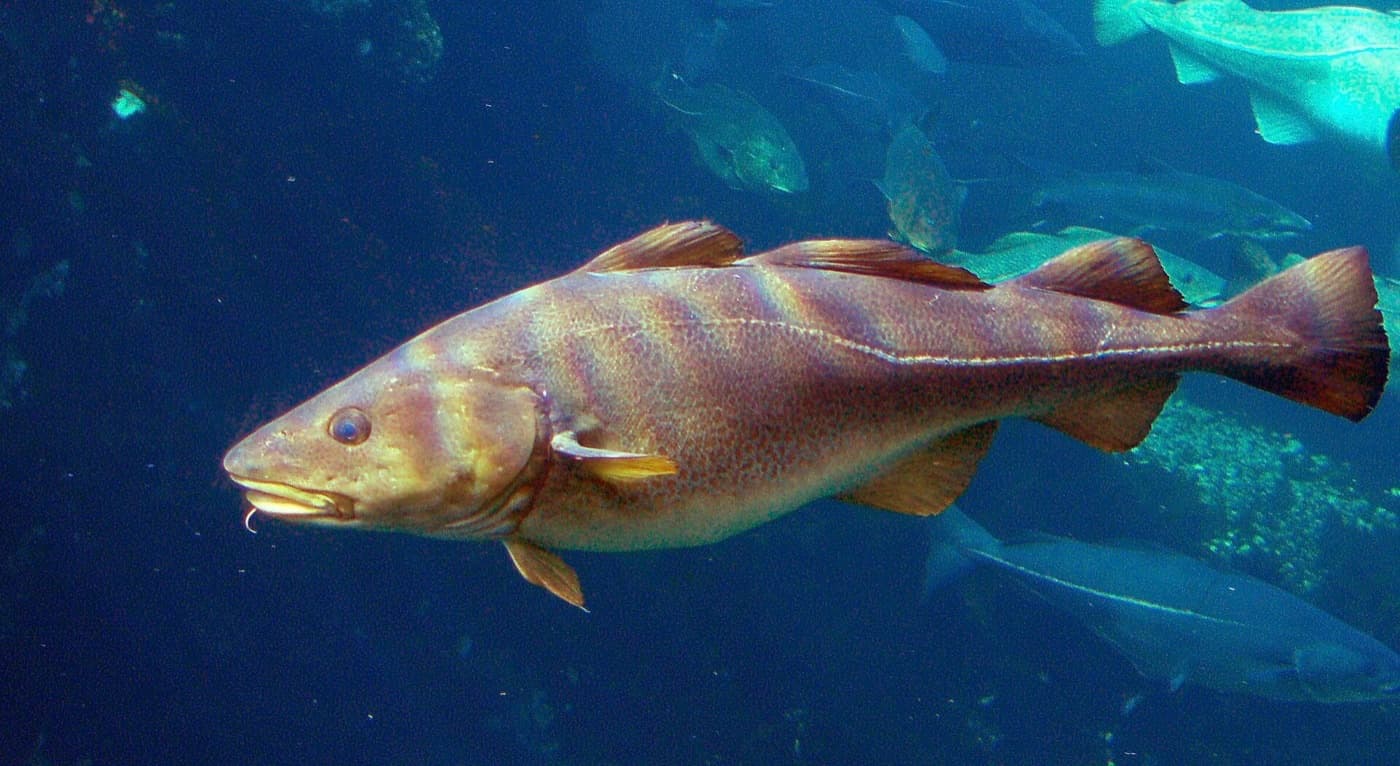
→Three dorsal fins, two anal fins and a barbel under the chin. Slight overbite.SourceFact from a specialist source · Applies to all regions1EncyclopediaStore norske leksikontorskAll sources on this page
→The colour varies with habitat and food: grey, olive green, brown or reddish brown with darker marbling. The belly is pale, almost white. Reddish-brown cod from the kelp forest is often called kelp cod (taretorsk).SourceFact from a specialist source · Applies to all regions1EncyclopediaStore norske leksikontorskAll sources on this page
Size
→South of StadCoastal cod south of 62°N rarely grow beyond 1 metre and 20 kg.SourceFact from a specialist source · Applies to: South of Stad22ResearchHavforskningsinstituttetKysttorsk – sør for 62ºNAll sources on this page
→The species can reach up to 180 cm and 55 kg, but coastal cod are considerably smaller than the migratory skrei.SourceFact from a specialist source · Applies to all regions1EncyclopediaStore norske leksikontorskAll sources on this page
→Coastal cod are more or less resident. Most Norwegian fjords of some size appear to have their own stocks.SourceFact from a specialist source · Applies to all regions1EncyclopediaStore norske leksikontorskAll sources on this page
→Feeds in fjords and coastal areas and spawns in fjord and coastal basins. The juveniles grow up in the shore zone, at 0–20 metres depth.SourceFact from a specialist source · Applies to all regions22ResearchHavforskningsinstituttetKysttorsk – sør for 62ºNAll sources on this page
→Lives mainly in water between 0 and about 10 °C.SourceFact from a specialist source · Applies to all regions1EncyclopediaStore norske leksikontorskAll sources on this page
The stock
→South of StadMost of the arrows point downwards for coastal cod in the south. In Western Norway, commercial landings have fallen by 88 per cent since 2000, and catch per unit of effort has gone down by about 50 per cent over the last 20 years.SourceFact from a specialist source · Applies to: South of Stad3ResearchHavforskningsinstituttetKysttorsk i sør er i fritt fall – og fiskene «krymper»All sources on this page
→South of StadThe Institute of Marine Research points to increased harvesting as the single factor with the greatest effect on the decline of adult cod in Western Norway and along the eastern part of the Skagerrak coast.SourceFact from a specialist source · Applies to: South of Stad22ResearchHavforskningsinstituttetKysttorsk – sør for 62ºNAll sources on this page
→North of StadBetween Stad and Gildeskål in Nordland (62–67°N), tourist and recreational fishing accounts for over half of the catch of coastal cod.SourceFact from a specialist source · Applies to: North of Stad4ResearchHavforskningsinstituttetKysttorsk – nord for 62ºNAll sources on this page
Experiences
Tips from people who have fished for Atlantic cod
From other anglers
Loading tips …
Experiences from readers. They have been read through, but not checked against sources, and do not count towards the source requirement. You will find rules only in the rules section. Tips are shown in the language they were written in, usually Norwegian.
Share an experience
Have you caught Atlantic cod? Tell us what worked for you.
Sources
What this page is based on
The numbers in the text refer to the sources below. Fishing tips must be confirmed by at least three independent sources. Read about our source requirements.