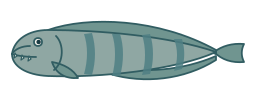
Skip to content
Fiskemanualen

How to fish for

Atlantic wolffish

Anarhichas lupus (gråsteinbit)SourcesFact from a specialist source · Applies to all regions1EncyclopediaStore norske leksikongråsteinbit2ResearchHavforskningsinstituttetSteinbitAll sources on this page

Also called (Norwegian names)gråsteinbitSourcesFact from a specialist source · Applies to all regions1EncyclopediaStore norske leksikongråsteinbit2ResearchHavforskningsinstituttetSteinbitAll sources on this page

The Atlantic wolffish (gråsteinbit) is the most common wolffish species along the coast, an elongated bottom fish with powerful jaws and teeth.SourcesFact from a specialist source · Applies to all regions1EncyclopediaStore norske leksikongråsteinbit2ResearchHavforskningsinstituttetSteinbitAll sources on this page

Southern and Eastern Norway: present. The Institute of Marine Research considers the stock to be poor in the south.SourcesFact from a specialist source · Applies to all regions2ResearchHavforskningsinstituttetSteinbit3ResearchHavforskningsinstituttetHI anbefaler fangstforbud for gråsteinbit sør for StadtAll sources on this page

Western Norway: present. The Institute of Marine Research considers the stock to be poor in the south.SourcesFact from a specialist source · Applies to all regions2ResearchHavforskningsinstituttetSteinbit3ResearchHavforskningsinstituttetHI anbefaler fangstforbud for gråsteinbit sør for StadtAll sources on this page

Central Norway: present. SourcesFact from a specialist source · Applies to all regions1EncyclopediaStore norske leksikongråsteinbit2ResearchHavforskningsinstituttetSteinbitAll sources on this page

Northern Norway: present. SourcesFact from a specialist source · Applies to all regions1EncyclopediaStore norske leksikongråsteinbit2ResearchHavforskningsinstituttetSteinbitAll sources on this page

Found in
Bottom
Best season
May–Aug
Methods
Drift fishing with bait on the bottom
Rules checked
29 September 2026

Getting started

Your first try for Atlantic wolffish

One recommended starting point: drift fishing with bait on the bottom from a boat. More methods are listed under “How to fish”.

  1. 1. Place and time

  2. 2. Tackle

    Hook
    Strong hooks. Alvestad usually uses 4/0–7/0, and Fiskeavisen uses a J-hook in size 4/0.SourcesTackle advice from a source of experience · Applies to all regions4ExperienceAsgeir AlvestadTid for steinbit6ExperienceFiskeavisenHvordan fiske steinbiten fra drivende småbåtAll sources on this page
    Rod and line
    A rod with some backbone, so that you can set a hard strike in the tooth-filled jaws. Alvestad mentions a 15–40 lb rod, and Jakt & Fiske a boat rod that can handle sinkers of 200–500 g, with 0.30–0.45 mm multifilament and a long, thick mono leader.SourcesTackle advice from a source of experience · Applies to all regions4ExperienceAsgeir AlvestadTid for steinbit7ExperienceJakt & FiskeSlik fisker du steinbitAll sources on this page
    Attractors
    Strong colours, spinner blades, squid, rubber tubes or beads. Alvestad believes wolffish like yellow and pink. Jakt & Fiske writes that most people bump the baits on the bottom and use strong colours.SourcesTackle advice from a source of experience · Applies to all regions4ExperienceAsgeir AlvestadTid for steinbit6ExperienceFiskeavisenHvordan fiske steinbiten fra drivende småbåt7ExperienceJakt & FiskeSlik fisker du steinbit8ExperienceAsgeir AlvestadSteinbit takkel (oppskrift steg for steg)All sources on this page
  3. 3. Rig up: boom rig with a trace

    1. 1Main line. Braided line from the reel.SourceTackle advice from a source of experience · Applies to all regions9ExperienceNormark Norway (elbe.no)Sjøfiske fra båtAll sources on this page
    2. 2Boom. A stiff arm that keeps the bait away from the main line, so the rig does not tangle on the way down.SourceTackle advice from a source of experience · Applies to all regions9ExperienceNormark Norway (elbe.no)Sjøfiske fra båtAll sources on this page
    3. 3Sinker. Attached to the boom, keeps the rig near the bottom.SourceTackle advice from a source of experience · Applies to all regions9ExperienceNormark Norway (elbe.no)Sjøfiske fra båtAll sources on this page
    4. 4Trace. A leader of 30 cm to 1 metre from the boom out to the hook and bait.SourceTackle advice from a source of experience · Applies to all regions9ExperienceNormark Norway (elbe.no)Sjøfiske fra båtAll sources on this page

    How to assemble it

    • Attach the boom to the main line and the sinker to the boom.SourceTackle advice from a source of experience · Applies to all regions9ExperienceNormark Norway (elbe.no)Sjøfiske fra båtAll sources on this page
    • Attach the trace to the boom. A leader of 30 cm to 1 metre makes the bait move more naturally.SourceTackle advice from a source of experience · Applies to all regions9ExperienceNormark Norway (elbe.no)Sjøfiske fra båtAll sources on this page
    • Bait with oily fish, for example mackerel fillet, and fish along the bottom while the boat drifts.SourceTackle advice from a source of experience · Applies to all regions9ExperienceNormark Norway (elbe.no)Sjøfiske fra båtAll sources on this page
  4. 4. How to do it

Words you will meet on this page
Leader:
A length of heavier line between the main line and the bait, which withstands wear better.SourcesTackle advice from a source of experience · Applies to all regions9ExperienceNormark Norway (elbe.no)Sjøfiske fra båt10OrganisationNorges Jeger- og FiskerforbundSlik får du fisk i saltvannAll sources on this page

Where

Where to find Atlantic wolffish

Where in the sea Atlantic wolffish livesAtlantic wolffish lives in bottom, from 20 to 60 metres depth.

Anglers most often fish for wolffish at 20–60 metres depth. Alvestad gives 10–60 and 20–70 metres, and Hooked states that it is found mostly down to 50–60 metres. In spring it can stay very shallow.SourcesFishing tip confirmed by 3 independent sources of experience · Applies to all regions4ExperienceAsgeir AlvestadTid for steinbit5ExperienceHooked.noHvordan fiske gråsteinbit – art nummer 7 / 526ExperienceFiskeavisenHvordan fiske steinbiten fra drivende småbåt8ExperienceAsgeir AlvestadSteinbit takkel (oppskrift steg for steg)All sources on this page Highlighted: bottomSourcesFishing tip from a specialist source · Applies to all regions2ResearchHavforskningsinstituttetSteinbit4ExperienceAsgeir AlvestadTid for steinbit5ExperienceHooked.noHvordan fiske gråsteinbit – art nummer 7 / 526ExperienceFiskeavisenHvordan fiske steinbiten fra drivende småbåt7ExperienceJakt & FiskeSlik fisker du steinbitAll sources on this page.

How to find it

Along the coast

Technique and tackle

How to fish for Atlantic wolffish

From boat

Drift fishing with bait on the bottom

Hook
Strong hooks. Alvestad usually uses 4/0–7/0, and Fiskeavisen uses a J-hook in size 4/0.SourcesTackle advice from a source of experience · Applies to all regions4ExperienceAsgeir AlvestadTid for steinbit6ExperienceFiskeavisenHvordan fiske steinbiten fra drivende småbåtAll sources on this page
Rod and line
A rod with some backbone, so that you can set a hard strike in the tooth-filled jaws. Alvestad mentions a 15–40 lb rod, and Jakt & Fiske a boat rod that can handle sinkers of 200–500 g, with 0.30–0.45 mm multifilament and a long, thick mono leader.SourcesTackle advice from a source of experience · Applies to all regions4ExperienceAsgeir AlvestadTid for steinbit7ExperienceJakt & FiskeSlik fisker du steinbitAll sources on this page
Attractors
Strong colours, spinner blades, squid, rubber tubes or beads. Alvestad believes wolffish like yellow and pink. Jakt & Fiske writes that most people bump the baits on the bottom and use strong colours.SourcesTackle advice from a source of experience · Applies to all regions4ExperienceAsgeir AlvestadTid for steinbit6ExperienceFiskeavisenHvordan fiske steinbiten fra drivende småbåt7ExperienceJakt & FiskeSlik fisker du steinbit8ExperienceAsgeir AlvestadSteinbit takkel (oppskrift steg for steg)All sources on this page

Bait

When

Season and time of day

Month by month

  1. JanJanuary: Rarely worthwhile
  2. FebFebruary: Rarely worthwhile
  3. MarMarch: Rarely worthwhile
  4. AprApril: Possible
  5. MayMay: Good
  6. JunJune: Good
  7. JulJuly: Good
  8. AugAugust: Good
  9. SepSeptember: Possible
  10. OctOctober: Rarely worthwhile
  11. NovNovember: Rarely worthwhile
  12. DecDecember: Rarely worthwhile
BestGoodPossibleRarely worthwhileSpawningSeasonSourcesFishing tip from a specialist source · Applies to all regions2ResearchHavforskningsinstituttetSteinbit4ExperienceAsgeir AlvestadTid for steinbit6ExperienceFiskeavisenHvordan fiske steinbiten fra drivende småbåt7ExperienceJakt & FiskeSlik fisker du steinbitAll sources on this page

The assessment covers the coast as a whole. The season can vary locally, and closed seasons may stop the fishing. See the rules further down.

Time of day

The time of day is not documented well enough to give advice.

Rules

Minimum sizes and closed seasons

Show rules for

Showing rules for the whole coast. Rules that apply to only part of the coast are labelled.Showing rules for Southern and Eastern Norway (Østfold to Agder (the Skagerrak coast)).Showing rules for Western Norway (Rogaland and Vestland, south of Stad).Showing rules for Central Norway (Møre og Romsdal and Trøndelag).Showing rules for Northern Norway (Nordland, Troms and Finnmark).

The rules are translated from Norwegian. Only the Norwegian text and the authorities’ own pages (in Norwegian) are authoritative. Check them before your trip.

Checked 29 September 2026 against Fiskeridirektoratet: Minstemål i fritidsfiske, Fiskeridirektoratet: Freda og delvis freda artar, Fiskeridirektoratet: Generelle reglar, Fiskeridirektoratet: Oslofjorden: tiltak for fritidsfiskere, Lovdata: Forskrift om regulering av fiske i Oslofjorden (FOR-2025-12-19-2889) and Lovdata: Forskrift om forbud mot fiske i gytefelt for torsk (FOR-2019-03-25-321).

Not checked: rules in national parks and other protected areas at sea and local rules adopted by the municipality. The regulations may change, so always check the current rules before your trip.

About the fish

Identification and life history

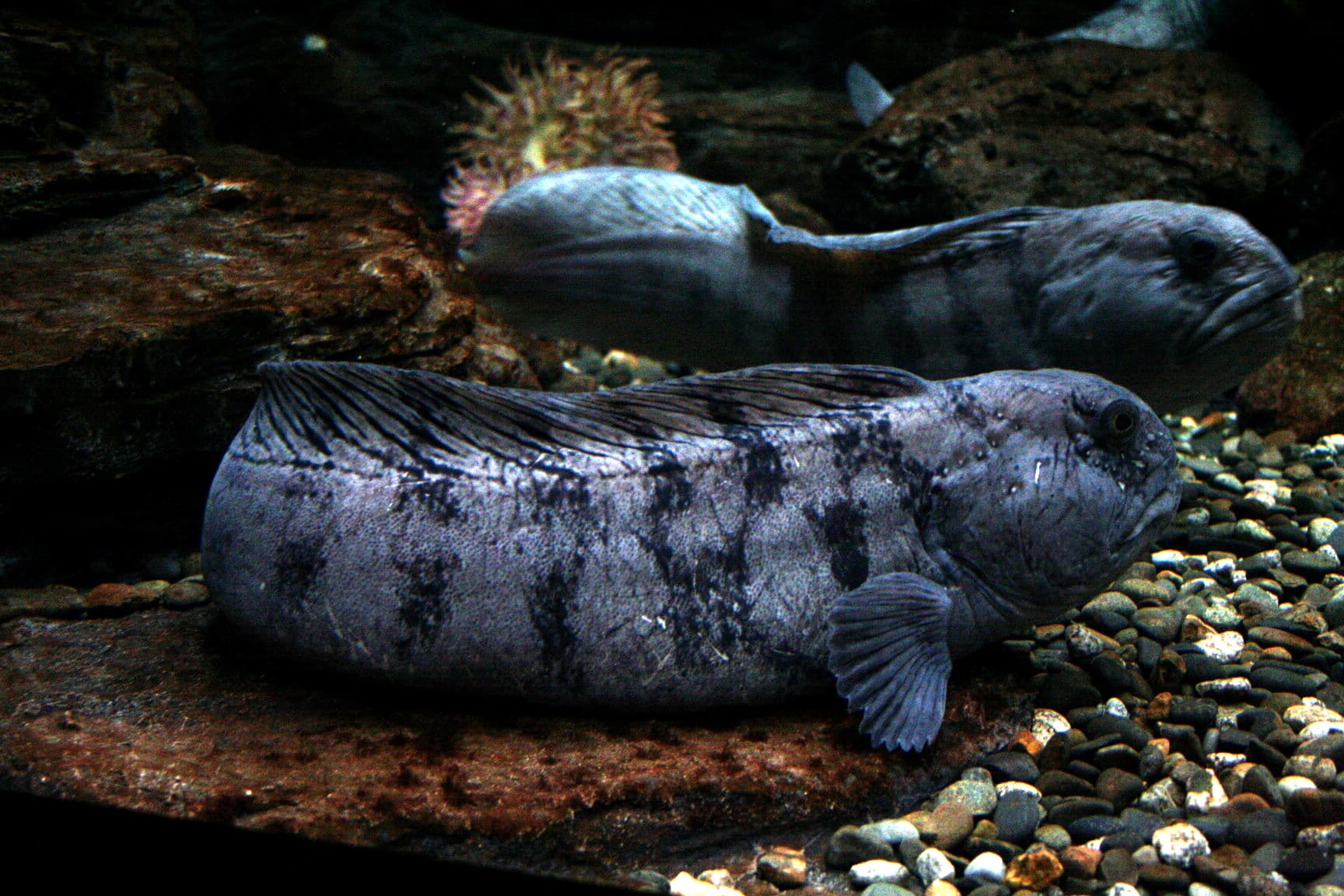
An Atlantic wolffish seen from the side in an aquarium, with a grey-blue body, dark cross bands and one long dorsal fin along the whole back
Photo: Strobilomyces, CC BY-SA 3.0, via Wikimedia Commons

Identification

  • Very powerful jaws and teeth.SourcesFact from a specialist source · Applies to all regions1EncyclopediaStore norske leksikongråsteinbit18EncyclopediaStore norske leksikonsteinbitAll sources on this page
  • Elongated body, flattened from the sides, with an unusually long dorsal and anal fin.SourcesFact from a specialist source · Applies to all regions1EncyclopediaStore norske leksikongråsteinbit18EncyclopediaStore norske leksikonsteinbitAll sources on this page
  • Usually grey-blue with black cross bands.SourceFact from a specialist source · Applies to all regions1EncyclopediaStore norske leksikongråsteinbitAll sources on this page

Size

  • Can reach up to 125 cm and 20 kg, and live for 20–25 years. Store norske leksikon gives up to 150 cm and over 20 kg.SourcesFact from a specialist source · Applies to all regions1EncyclopediaStore norske leksikongråsteinbit2ResearchHavforskningsinstituttetSteinbitAll sources on this page

Diet

  • Sea urchins, bivalves, snails and crabs. The jaw is so powerful that it easily crushes bivalves and sea urchins.SourcesFact from a specialist source · Applies to all regions1EncyclopediaStore norske leksikongråsteinbit2ResearchHavforskningsinstituttetSteinbitAll sources on this page

Life history

  • The Atlantic wolffish is much more stationary than the northern and spotted wolffish, more coastal, and lives in shallower water. It stays in relatively shallow water where the bottom is rocky.SourcesFact from a specialist source · Applies to all regions1EncyclopediaStore norske leksikongråsteinbit2ResearchHavforskningsinstituttetSteinbitAll sources on this page
  • The Atlantic wolffish spawns near the coast, in fjords and coves at 50–150 metres depth. The female lays all the eggs in a cluster or ball on the bottom, and the male guards them until they hatch after several months.SourcesFact from a specialist source · Applies to all regions1EncyclopediaStore norske leksikongråsteinbit2ResearchHavforskningsinstituttetSteinbitAll sources on this page
  • Wolffish change their teeth in winter. The Institute of Marine Research writes that they stop feeding from October to May.SourcesFact from a specialist source · Applies to all regions2ResearchHavforskningsinstituttetSteinbit18EncyclopediaStore norske leksikonsteinbitAll sources on this page
  • The Atlantic wolffish becomes sexually mature when it is 6–7 years old.SourceFact from a specialist source · Applies to all regions3ResearchHavforskningsinstituttetHI anbefaler fangstforbud for gråsteinbit sør for StadtAll sources on this page
  • Found along the whole Norwegian coast and in the North Sea.SourcesFact from a specialist source · Applies to all regions1EncyclopediaStore norske leksikongråsteinbit2ResearchHavforskningsinstituttetSteinbitAll sources on this page

The stock

  • South of StadThe Institute of Marine Research has recommended a catch ban of at least ten years for Atlantic wolffish south of Stad inside the territorial limit, with mandatory release of all catches. The recommendation also applies to recreational fishing. This is a recommendation from the Institute, in response to a request from the Directorate of Fisheries for knowledge support to assess protection.SourceFact from a specialist source · Applies to: South of Stad3ResearchHavforskningsinstituttetHI anbefaler fangstforbud for gråsteinbit sør for StadtAll sources on this page
  • The Institute of Marine Research considers the stock of Atlantic wolffish along the Norwegian coast to be poor, especially in Southern Norway (the North Sea and Skagerrak), where it is widely reduced.SourceFact from a specialist source · Applies to all regions3ResearchHavforskningsinstituttetHI anbefaler fangstforbud for gråsteinbit sør for StadtAll sources on this page
  • The Institute also recommends a biologically based minimum size where fishing for Atlantic wolffish is still allowed, because the species is slow-growing and only becomes sexually mature at 6–7 years.SourceFact from a specialist source · Applies to all regions3ResearchHavforskningsinstituttetHI anbefaler fangstforbud for gråsteinbit sør for StadtAll sources on this page
  • The Atlantic wolffish is a key species in the coastal ecosystem. It keeps the sea urchin population down, and its decline is regarded as a main reason why the kelp forest has been overgrazed in Northern Norway.SourceFact from a specialist source · Applies to all regions3ResearchHavforskningsinstituttetHI anbefaler fangstforbud for gråsteinbit sør for StadtAll sources on this page
  • Along the Norwegian coast there is a lack of data on the state of the stock. Catch statistics suggest that catches north of Stad have been stable since 2000, while the statistics south of Stad may indicate a decline.SourceFact from a specialist source · Applies to all regions1EncyclopediaStore norske leksikongråsteinbitAll sources on this page
  • Northern NorwayIn the Saltstraumen marine protected area, all fishing for wolffish has been prohibited since 26 August 2024.SourceFact from a specialist source · Applies to: Northern Norway18EncyclopediaStore norske leksikonsteinbitAll sources on this page

Experiences

Tips from people who have fished for Atlantic wolffish

From other anglers

Loading tips …

Experiences from readers. They have been read through, but not checked against sources, and do not count towards the source requirement. You will find rules only in the rules section. Tips are shown in the language they were written in, usually Norwegian.

Share an experience

Have you caught Atlantic wolffish? Tell us what worked for you.

Sources

What this page is based on

The numbers in the text refer to the sources below. Fishing tips must be confirmed by at least three independent sources. Read about our source requirements.

  1. 1
    EncyclopediaStore norske leksikon
    gråsteinbit

    Read 29 September 2026

  2. 2
    ResearchHavforskningsinstituttet
    Steinbit

    Read 29 September 2026

  3. 3
    ResearchHavforskningsinstituttet
    HI anbefaler fangstforbud for gråsteinbit sør for Stadt

    Published 25 June 2026 · Read 29 September 2026

  4. 4
    ExperienceAsgeir Alvestad
    Tid for steinbit

    Asgeir Alvestad · Published 5 May 2021 · Read 29 September 2026

  5. 5
    ExperienceHooked.no
    Hvordan fiske gråsteinbit – art nummer 7 / 52

    Published 11 October 2011 · Read 29 September 2026

  6. 6
    ExperienceFiskeavisen
    Hvordan fiske steinbiten fra drivende småbåt

    Published 1 September 2017 · Read 29 September 2026

  7. 7
    ExperienceJakt & Fiske
    Slik fisker du steinbit

    Tommy Egra · Published 5 June 2020 · Read 29 September 2026

  8. 8
    ExperienceAsgeir Alvestad
    Steinbit takkel (oppskrift steg for steg)

    Asgeir Alvestad · Published 27 February 2024 · Read 29 September 2026

  9. 9
    ExperienceNormark Norway (elbe.no)
    Sjøfiske fra båt

    Published 20 April 2020 · Read 29 September 2026

  10. 10
    OrganisationNorges Jeger- og Fiskerforbund
    Slik får du fisk i saltvann

    Read 29 September 2026

  11. 11
    AuthorityFiskeridirektoratet
    Minstemål i fritidsfiske

    Read 29 September 2026

  12. 12
    AuthorityFiskeridirektoratet
    Freda og delvis freda artar

    Read 29 September 2026

  13. 13
  14. 14
  15. 15
    AuthorityFiskeridirektoratet
    Oslofjorden: tiltak for fritidsfiskere

    Read 29 September 2026

  16. 16
  17. 17
    AuthorityFiskeridirektoratet
    Generelle reglar

    Read 29 September 2026

  18. 18
    EncyclopediaStore norske leksikon
    steinbit

    Leif Asbjørn Vøllestad · Read 29 September 2026