Salmo truttaSourceFact from a specialist source · Applies to all regions1EncyclopediaStore norske leksikonørretAll sources on this page
Also called (Norwegian names)ørretsjøaureauresjøblankebyrtingstrendingSourceFact from a specialist source · Applies to all regions1EncyclopediaStore norske leksikonørretAll sources on this page
Sea trout is brown trout that grows big in the sea but spawns in fresh water.SourceFact from a specialist source · Applies to all regions1EncyclopediaStore norske leksikonørretAll sources on this page
Southern and Eastern Norway: present.SourceFact from a specialist source · Applies to all regions2ResearchHavforskningsinstituttetØrret (aure)All sources on this page
Western Norway: present. Many stocks have been weakened by salmon lice, including in the Hardangerfjord.SourceFact from a specialist source · Applies to all regions2ResearchHavforskningsinstituttetØrret (aure)All sources on this page
Central Norway: present.SourceFact from a specialist source · Applies to all regions2ResearchHavforskningsinstituttetØrret (aure)All sources on this page
Northern Norway: present.SourceFact from a specialist source · Applies to all regions2ResearchHavforskningsinstituttetØrret (aure)All sources on this page
Found in
Surface
Best season
Mar–May
Methods
Lures and plugs, Fly, Trolling
Rules checked
29 September 2026
Getting started
Your first try for sea trout
One recommended starting point: lures and plugs from shore or from a boat. More methods are listed under “How to fish”.
11–14 cm when the water is cold and 7–11 cm when it is warm.SourceTackle advice from a source of experience · Applies to all regions3ExperienceHooked.noSlik fisker du sjøørretAll sources on this page
2Leader. 1–2 metres of monofilament or fluorocarbon between the main line and the lure. It withstands abrasion against rock and is less visible.SourcesTackle advice from a source of experience · Applies to all regions8OrganisationNorges Jeger- og FiskerforbundSlik får du fisk i saltvann9ExperienceHooked.noTorskefiske fra land i vinterhalvåretAll sources on this page
Østfold to Agder (the Skagerrak coast)SourceFact from a specialist source · Applies to all regions2ResearchHavforskningsinstituttetØrret (aure)All sources on this page
Western NorwayPresent
Many stocks have been weakened by salmon lice, including in the Hardangerfjord.SourceFact from a specialist source · Applies to all regions2ResearchHavforskningsinstituttetØrret (aure)All sources on this page
Central NorwayPresent
Møre og Romsdal and TrøndelagSourceFact from a specialist source · Applies to all regions2ResearchHavforskningsinstituttetØrret (aure)All sources on this page
Northern NorwayPresent
Nordland, Troms and FinnmarkSourceFact from a specialist source · Applies to all regions2ResearchHavforskningsinstituttetØrret (aure)All sources on this page
11–14 cm when the water is cold and 7–11 cm when it is warm.SourceTackle advice from a source of experience · Applies to all regions3ExperienceHooked.noSlik fisker du sjøørretAll sources on this page
From shore
Fly
→Fly fishing at sea is usually done with colourful streamers and large dark bristle worm imitations. Spring is regarded as the best time.SourceFishing tip from a specialist source · Applies to all regions1EncyclopediaStore norske leksikonørretAll sources on this page
→Winter: white and orange. Spring and autumn: green, yellow and red. Summer: blue, olive and brown.SourceTackle advice from a source of experience · Applies to all regions3ExperienceHooked.noSlik fisker du sjøørretAll sources on this page
→Silver works best in overcast weather, gold and copper in sun.SourceTackle advice from a source of experience · Applies to all regions3ExperienceHooked.noSlik fisker du sjøørretAll sources on this page
→Blue, white and green lures are widely used. Try white when the water is cold.SourceTackle advice from a source of experience · Applies to all regions4ExperienceNordic Outdoor (Sølvkroken)Tips til sjøørretfiskeAll sources on this page
→Western Norway, Central Norway, Northern NorwayIn spring sea trout are protected in Trøndelag (1 March–31 May), in Møre og Romsdal except Smøla (1 March–30 April), in inner Ryfylke and the Hardangerfjord (1 March–30 April) and when fishing from a boat in Nordland (1 March–31 May).SourceRule from the authorities · Applies to: Western Norway, Central Norway, Northern Norway14AuthorityLovdataForskrift om fiske etter anadrome laksefisk i sjøen (FOR-2021-03-15-797)All sources on this page
Showing rules for the whole coast. Rules that apply to only part of the coast are labelled.Showing rules for Southern and Eastern Norway (Østfold to Agder (the Skagerrak coast)).Showing rules for Western Norway (Rogaland and Vestland, south of Stad).Showing rules for Central Norway (Møre og Romsdal and Trøndelag).Showing rules for Northern Norway (Nordland, Troms and Finnmark).
→Northern NorwayMinimum size for sea trout in Nordland, Troms and Finnmark: 30 cm.SourceRule from the authorities · Applies to: Northern Norway16AuthorityFiskeridirektoratetMinstemål i fritidsfiskeAll sources on this page
→Southern and Eastern Norway, Western Norway, Central NorwayMinimum size for sea trout from the Swedish border to and including Trøndelag: 35 cm.SourceRule from the authorities · Applies to: Southern and Eastern Norway, Western Norway, Central Norway16AuthorityFiskeridirektoratetMinstemål i fritidsfiskeAll sources on this page
→The Directorate of Fisheries’ overview of protected and partially protected species does not mention sea trout.SourceRule from the authorities · Applies to all regions17AuthorityFiskeridirektoratetFreda og delvis freda artarAll sources on this page
→ImportantWestern NorwayFrom 1 March to 30 April inclusive, it is prohibited to fish for sea trout and salmon from shore and boat in the Ryfylke fjords inside Tungenes–Kårstø (except the Lysefjord inside the Lysefjord Bridge and the Skjoldafjord north of Borgøyna) and in the Hardangerfjord inside Bleiknes at Husnes–Ystadnes at Ølve.SourceRule from the authorities · Applies to: Western Norway14AuthorityLovdataForskrift om fiske etter anadrome laksefisk i sjøen (FOR-2021-03-15-797)All sources on this page
→If you catch a fish under the minimum size, wet your hands, release the fish carefully and let it go. If the fish is dead or not viable, you may keep it.SourceRule from the authorities · Applies to all regions16AuthorityFiskeridirektoratetMinstemål i fritidsfiskeAll sources on this page
→It is prohibited to fish closer than 100 metres to fish farms.SourceRule from the authorities · Applies to all regions24AuthorityFiskeridirektoratetGenerelle reglarAll sources on this page
→It is not permitted to use live fish or other live animals as bait.SourceRule from the authorities · Applies to all regions24AuthorityFiskeridirektoratetGenerelle reglarAll sources on this page
→Northern NorwaySeparate local restrictions may apply, for example for the cod fishery in Lofoten.SourceRule from the authorities · Applies to: Northern Norway24AuthorityFiskeridirektoratetGenerelle reglarAll sources on this page
The rules are translated from Norwegian. Only the Norwegian text and the authorities’ own pages (in Norwegian) are authoritative. Check them before your trip.
Not checked: rules in national parks and other protected areas at sea and local rules adopted by the municipality. The regulations may change, so always check the current rules before your trip.
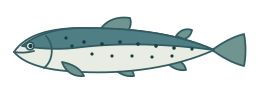
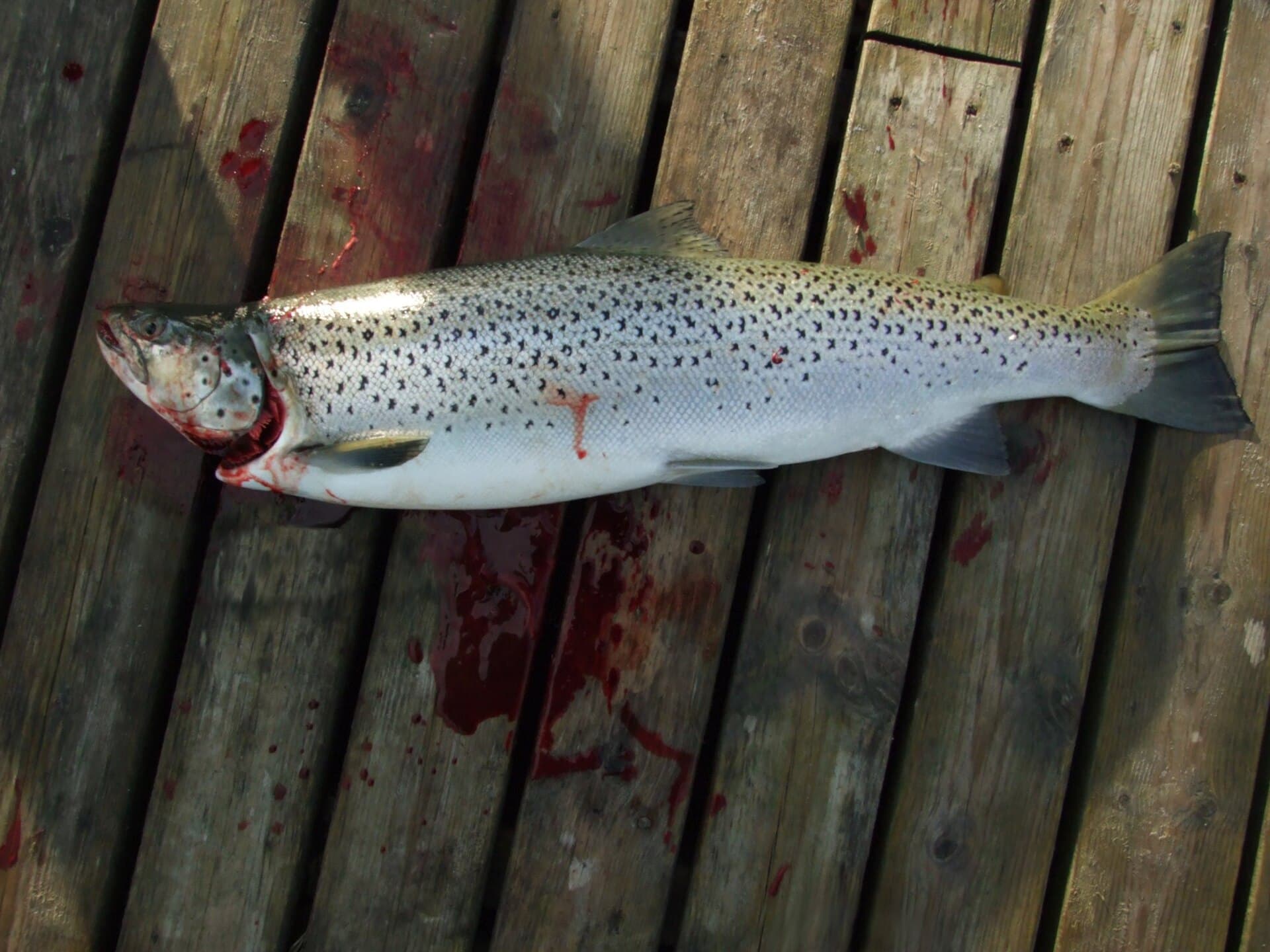
→When the trout migrates to sea, it gets a distinct silvery shine and is called sea trout.SourceFact from a specialist source · Applies to all regions1EncyclopediaStore norske leksikonørretAll sources on this page
→Trout resembles salmon, but has a somewhat sturdier build, a deeper tail wrist and more spots on the sides.SourceFact from a specialist source · Applies to all regions1EncyclopediaStore norske leksikonørretAll sources on this page
Size
→Trout are generally smaller than salmon, but can exceptionally reach 15 kg and more, and are then about one metre long.SourceFact from a specialist source · Applies to all regions1EncyclopediaStore norske leksikonørretAll sources on this page
→In the rivers that flow into the Sognefjord, sea trout of 5–8 kg are not unusual.SourceFact from a specialist source · Applies to all regions1EncyclopediaStore norske leksikonørretAll sources on this page
Diet
→Young trout in flowing water eat drifting insects, and gradually small fish as well.SourceFact from a specialist source · Applies to all regions1EncyclopediaStore norske leksikonørretAll sources on this page
Life history
→All trout, including sea trout, reproduce only in fresh water. Spawning usually takes place in a river or stream.SourceFact from a specialist source · Applies to all regions1EncyclopediaStore norske leksikonørretAll sources on this page
→The young trout first live in flowing water. When they are 10–20 cm and 2–5 years old, they migrate downstream to a lake or out to sea, most often in spring.SourceFact from a specialist source · Applies to all regions1EncyclopediaStore norske leksikonørretAll sources on this page
→The spawning season is usually September–October, but can exceptionally be as late as December–January.SourceFact from a specialist source · Applies to all regions1EncyclopediaStore norske leksikonørretAll sources on this page
The stock
Experiences
Tips from people who have fished for sea trout
From other anglers
Loading tips …
Experiences from readers. They have been read through, but not checked against sources, and do not count towards the source requirement. You will find rules only in the rules section. Tips are shown in the language they were written in, usually Norwegian.
Share an experience
Have you caught sea trout? Tell us what worked for you.
Sources
What this page is based on
The numbers in the text refer to the sources below. Fishing tips must be confirmed by at least three independent sources. Read about our source requirements.