Pollachius virensSourcesFact from a specialist source · Applies to all regions1EncyclopediaStore norske leksikonsei2ResearchHavforskningsinstituttetSei – NordsjøenAll sources on this page
Also called (Norwegian names)palemortkotseikodhølingSourceFact from a specialist source · Applies to all regions1EncyclopediaStore norske leksikonseiAll sources on this page
Saithe is a schooling fish in the cod family that often stays in the upper water layers.SourceFact from a specialist source · Applies to all regions1EncyclopediaStore norske leksikonseiAll sources on this page
Southern and Eastern Norway: present.SourcesFact from a specialist source · Applies to all regions1EncyclopediaStore norske leksikonsei2ResearchHavforskningsinstituttetSei – NordsjøenAll sources on this page
Western Norway: present. Young saithe grow up in the shore zone from Western Norway and northwards.SourceFact from a specialist source · Applies to all regions3ResearchHavforskningsinstituttetSei – nordaustarktiskAll sources on this page
Central Norway: common. The coast north of Stad is the main area for Northeast Arctic saithe.SourceFact from a specialist source · Applies to all regions3ResearchHavforskningsinstituttetSei – nordaustarktiskAll sources on this page
Northern Norway: common. The coast north of Stad is the main area for Northeast Arctic saithe. Young saithe are found in the shore zone all the way north to Finnmark.SourcesFact from a specialist source · Applies to all regions1EncyclopediaStore norske leksikonsei3ResearchHavforskningsinstituttetSei – nordaustarktiskAll sources on this page
Found in
Surface and open water and bottom
Best season
Sep–Nov
Methods
Lure fishing from shore, Pilk and droppers from a boat
Rules checked
29 September 2026
Getting started
Your first try for saithe
One recommended starting point: lure fishing from shore from shore. More methods are listed under “How to fish”.
1. Place and time
Saithe move around a lot, both up and down in the water layers and along the coast. Try different depths, and move often.SourcesFishing tip from a specialist source · Applies to all regions1EncyclopediaStore norske leksikonsei4OrganisationNorges Jeger- og FiskerforbundSei5Experienceasgeiralvestad.noTips og triks hvis du vil fiske seiAll sources on this page
Best in Sep–Nov.
2. Tackle
Rod and line
Spinning rod of 9–10 feet with lure weight up to 40 g and a medium-sized reel with 0.20 mm braided line.SourceTackle advice from a source of experience · Applies to all regions5Experienceasgeiralvestad.noTips og triks hvis du vil fiske seiAll sources on this page
2Leader. 1–2 metres of monofilament or fluorocarbon between the main line and the lure. It withstands abrasion against rock and is less visible.SourcesTackle advice from a source of experience · Applies to all regions6OrganisationNorges Jeger- og FiskerforbundSlik får du fisk i saltvann7ExperienceHooked.noTorskefiske fra land i vinterhalvåretAll sources on this page
→Slim herring lures are a good choice from shore. They give long casts and resemble what the saithe are chasing.SourcesFishing tip confirmed by 3 independent sources of experience · Applies to all regions4OrganisationNorges Jeger- og FiskerforbundSei5Experienceasgeiralvestad.noTips og triks hvis du vil fiske sei8ExperienceSølvkrokenSlik fisker du sei og lyrAll sources on this page
→Fish in several water layers, from near the bottom up towards the surface, until you find the fish.SourcesFishing tip confirmed by 4 independent sources of experience · Applies to all regions4OrganisationNorges Jeger- og FiskerforbundSei5Experienceasgeiralvestad.noTips og triks hvis du vil fiske sei8ExperienceSølvkrokenSlik fisker du sei og lyr9ExperienceNormark Norway (elbe.no)Sjøfiske fra båtAll sources on this page
A length of heavier line between the main line and the bait, which withstands wear better.SourcesTackle advice from a source of experience · Applies to all regions6OrganisationNorges Jeger- og FiskerforbundSlik får du fisk i saltvann9ExperienceNormark Norway (elbe.no)Sjøfiske fra båtAll sources on this page
From the surface down to around 200 metres, depending on where the saithe are hunting. The Institute of Marine Research gives 0–600 metres for the species.SourcesFishing tip from a specialist source · Applies to all regions2ResearchHavforskningsinstituttetSei – Nordsjøen9ExperienceNormark Norway (elbe.no)Sjøfiske fra båtAll sources on this page Highlighted: surface and open water and bottomSourcesFishing tip from a specialist source · Applies to all regions2ResearchHavforskningsinstituttetSei – Nordsjøen4OrganisationNorges Jeger- og FiskerforbundSei5Experienceasgeiralvestad.noTips og triks hvis du vil fiske sei8ExperienceSølvkrokenSlik fisker du sei og lyrAll sources on this page.
How to find it
→Saithe move around a lot, both up and down in the water layers and along the coast. Try different depths, and move often.SourcesFishing tip from a specialist source · Applies to all regions1EncyclopediaStore norske leksikonsei4OrganisationNorges Jeger- og FiskerforbundSei5Experienceasgeiralvestad.noTips og triks hvis du vil fiske seiAll sources on this page
Østfold to Agder (the Skagerrak coast)SourcesFact from a specialist source · Applies to all regions1EncyclopediaStore norske leksikonsei2ResearchHavforskningsinstituttetSei – NordsjøenAll sources on this page
Western NorwayPresent
Young saithe grow up in the shore zone from Western Norway and northwards.SourceFact from a specialist source · Applies to all regions3ResearchHavforskningsinstituttetSei – nordaustarktiskAll sources on this page
Central NorwayCommon
The coast north of Stad is the main area for Northeast Arctic saithe.SourceFact from a specialist source · Applies to all regions3ResearchHavforskningsinstituttetSei – nordaustarktiskAll sources on this page
Northern NorwayCommon
The coast north of Stad is the main area for Northeast Arctic saithe. Young saithe are found in the shore zone all the way north to Finnmark.SourcesFact from a specialist source · Applies to all regions1EncyclopediaStore norske leksikonsei3ResearchHavforskningsinstituttetSei – nordaustarktiskAll sources on this page
Technique and tackle
How to fish for saithe
From shore
Lure fishing from shore
→Slim herring lures are a good choice from shore. They give long casts and resemble what the saithe are chasing.SourcesFishing tip confirmed by 3 independent sources of experience · Applies to all regions4OrganisationNorges Jeger- og FiskerforbundSei5Experienceasgeiralvestad.noTips og triks hvis du vil fiske sei8ExperienceSølvkrokenSlik fisker du sei og lyrAll sources on this page
→Fish in several water layers, from near the bottom up towards the surface, until you find the fish.SourcesFishing tip confirmed by 4 independent sources of experience · Applies to all regions4OrganisationNorges Jeger- og FiskerforbundSei5Experienceasgeiralvestad.noTips og triks hvis du vil fiske sei8ExperienceSølvkrokenSlik fisker du sei og lyr9ExperienceNormark Norway (elbe.no)Sjøfiske fra båtAll sources on this page
Spinning rod of 9–10 feet with lure weight up to 40 g and a medium-sized reel with 0.20 mm braided line.SourceTackle advice from a source of experience · Applies to all regions5Experienceasgeiralvestad.noTips og triks hvis du vil fiske seiAll sources on this page
8-foot rod of 30–40 lb (300–400 g lure weight) for big saithe. For small saithe in schools, all-round tackle of 15–40 lb (150–400 g) is enough.SourceTackle advice from a source of experience · Applies to all regions5Experienceasgeiralvestad.noTips og triks hvis du vil fiske seiAll sources on this page
Line
Braided main line of 0.32 mm with a long leader, so that the droppers are spread out.SourceTackle advice from a source of experience · Applies to all regions5Experienceasgeiralvestad.noTips og triks hvis du vil fiske seiAll sources on this page
→In summer, saithe can be fished with lures, fly or bait.SourceFishing tip from a specialist source · Applies to all regions1EncyclopediaStore norske leksikonseiAll sources on this page
Tips
→Saithe move around a lot, so fish actively and move often rather than waiting for the fish to come to you.SourcesFishing tip from a specialist source · Applies to all regions1EncyclopediaStore norske leksikonsei4OrganisationNorges Jeger- og FiskerforbundSei5Experienceasgeiralvestad.noTips og triks hvis du vil fiske seiAll sources on this page
→Green, blue and black are favourite colours for rubber worms and dropper flies for saithe. On pilks, silver, blue and green are often used.SourceTackle advice from a source of experience · Applies to all regions5Experienceasgeiralvestad.noTips og triks hvis du vil fiske seiAll sources on this page
→Green and blue are considered good herring colours on lures for saithe and pollack.SourceTackle advice from a source of experience · Applies to all regions8ExperienceSølvkrokenSlik fisker du sei og lyrAll sources on this page
→Saithe in the North Sea spawn in February–March.SourceFact from a specialist source · Applies to all regions2ResearchHavforskningsinstituttetSei – NordsjøenAll sources on this page
Rules
Minimum sizes and closed seasons
Show rules for
Showing rules for the whole coast. Rules that apply to only part of the coast are labelled.Showing rules for Southern and Eastern Norway (Østfold to Agder (the Skagerrak coast)).Showing rules for Western Norway (Rogaland and Vestland, south of Stad).Showing rules for Central Norway (Møre og Romsdal and Trøndelag).Showing rules for Northern Norway (Nordland, Troms and Finnmark).
→There is no minimum size for saithe for recreational fishers, as long as you are not going to sell the catch.SourceRule from the authorities · Applies to all regions12AuthorityFiskeridirektoratetMinstemål i fritidsfiskeAll sources on this page
→Saithe is not on the Directorate of Fisheries’ overview of protected and partially protected species.SourceRule from the authorities · Applies to all regions13AuthorityFiskeridirektoratetFreda og delvis freda artarAll sources on this page
→It is prohibited to fish closer than 100 metres to fish farms.SourceRule from the authorities · Applies to all regions18AuthorityFiskeridirektoratetGenerelle reglarAll sources on this page
→It is not permitted to use live fish or other live animals as bait.SourceRule from the authorities · Applies to all regions18AuthorityFiskeridirektoratetGenerelle reglarAll sources on this page
→Northern NorwaySeparate local restrictions may apply, for example for the cod fishery in Lofoten.SourceRule from the authorities · Applies to: Northern Norway18AuthorityFiskeridirektoratetGenerelle reglarAll sources on this page
The rules are translated from Norwegian. Only the Norwegian text and the authorities’ own pages (in Norwegian) are authoritative. Check them before your trip.
Not checked: rules in national parks and other protected areas at sea and local rules adopted by the municipality. The regulations may change, so always check the current rules before your trip.
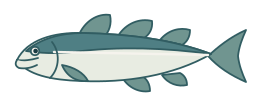
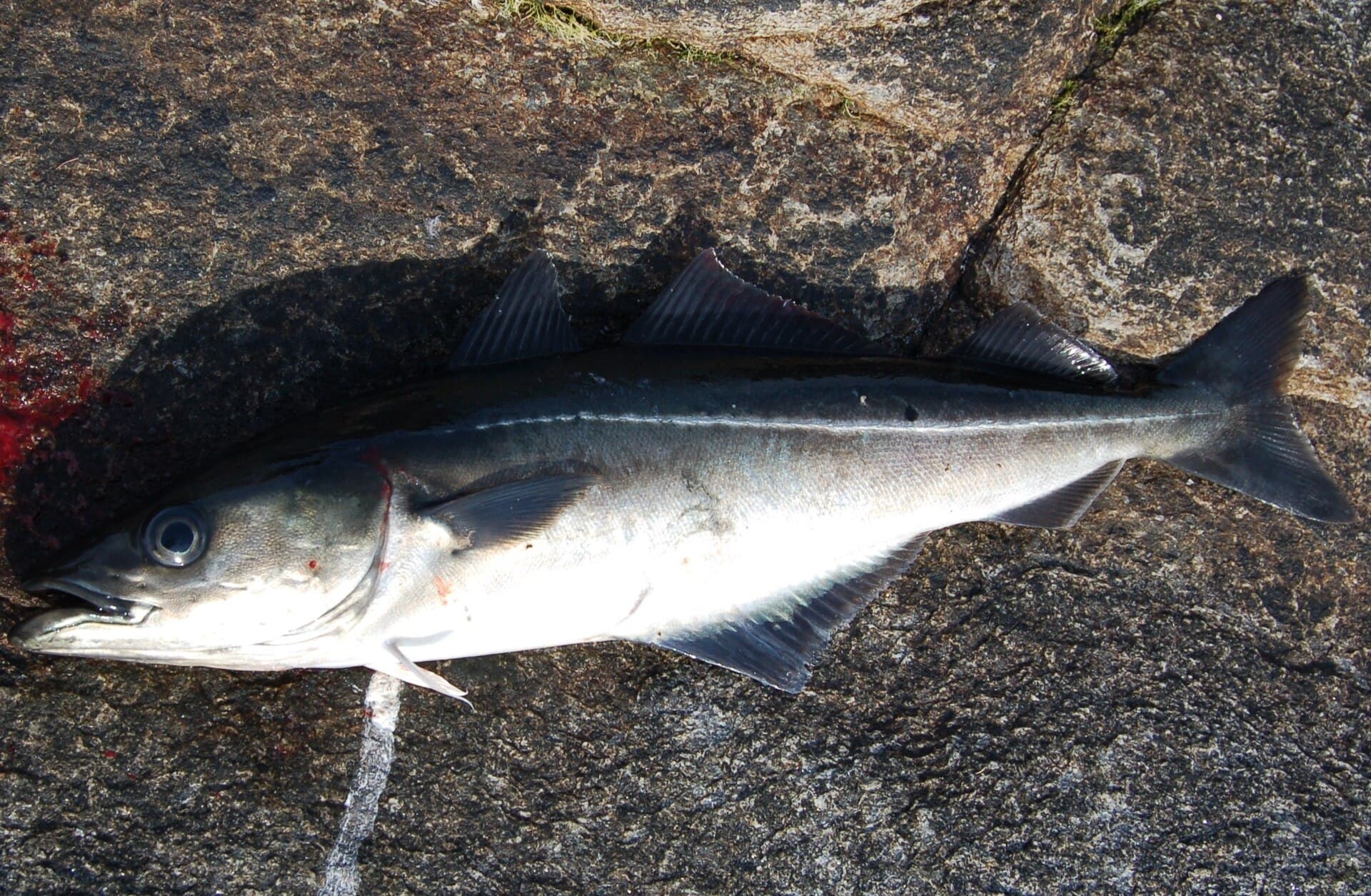
→The belly and sides are silvery grey, while the back is dark bluish green to black. The large mouth has a distinct underbite.SourceFact from a specialist source · Applies to all regions1EncyclopediaStore norske leksikonseiAll sources on this page
→The lateral line is pale, almost white in older fish, and nearly straight. The straight lateral line separates saithe from pollack, which is otherwise quite similar.SourceFact from a specialist source · Applies to all regions1EncyclopediaStore norske leksikonseiAll sources on this page
→Can grow to over 1 metre and up to 20 kg.SourcesFact from a specialist source · Applies to all regions1EncyclopediaStore norske leksikonsei2ResearchHavforskningsinstituttetSei – NordsjøenAll sources on this page
→Becomes sexually mature at about 50 cm and from around four years of age.SourcesFact from a specialist source · Applies to all regions1EncyclopediaStore norske leksikonsei2ResearchHavforskningsinstituttetSei – NordsjøenAll sources on this page
Diet
→Young saithe eat krill and raudåte (red copepods). Larger saithe eat more and more fish, such as herring, sprat, blue whiting and Norway pout.SourceFact from a specialist source · Applies to all regions1EncyclopediaStore norske leksikonseiAll sources on this page
Life history
→Saithe is a schooling fish that often stays in the upper water layers. Older and larger fish often stay deeper than young saithe.SourcesFact from a specialist source · Applies to all regions1EncyclopediaStore norske leksikonsei2ResearchHavforskningsinstituttetSei – NordsjøenAll sources on this page
→Found both in open water and near the bottom, from 0 to 600 metres depth.SourceFact from a specialist source · Applies to all regions2ResearchHavforskningsinstituttetSei – NordsjøenAll sources on this page
→Saithe migrate a lot and far.SourcesFact from a specialist source · Applies to all regions1EncyclopediaStore norske leksikonsei2ResearchHavforskningsinstituttetSei – NordsjøenAll sources on this page
→Spawns in the first months of the year. Eggs and fry drift with the ocean currents, and at first the saithe live in the shore zone.SourcesFact from a specialist source · Applies to all regions1EncyclopediaStore norske leksikonsei2ResearchHavforskningsinstituttetSei – NordsjøenAll sources on this page
The stock
→The Institute of Marine Research recommends a quota of 48,320 tonnes of saithe in the North Sea, Skagerrak and west of Scotland for 2027, against 60,167 tonnes for 2026. The news list on the page describes the quota advice from June 2026 as the lowest ever for saithe.SourceFact from a specialist source · Applies to all regions2ResearchHavforskningsinstituttetSei – NordsjøenAll sources on this page
→Saithe are mainly caught by trawl.SourcesFact from a specialist source · Applies to all regions1EncyclopediaStore norske leksikonsei2ResearchHavforskningsinstituttetSei – NordsjøenAll sources on this page
Experiences
Tips from people who have fished for saithe
From other anglers
Loading tips …
Experiences from readers. They have been read through, but not checked against sources, and do not count towards the source requirement. You will find rules only in the rules section. Tips are shown in the language they were written in, usually Norwegian.
Share an experience
Have you caught saithe? Tell us what worked for you.
Sources
What this page is based on
The numbers in the text refer to the sources below. Fishing tips must be confirmed by at least three independent sources. Read about our source requirements.