Salmo truttaSourceFact from a specialist source · Applies to all regions1EncyclopediaStore norske leksikonørretAll sources on this page
Also called (Norwegian names)aurebekkeørretbekkeaurekjøeSourceFact from a specialist source · Applies to all regions1EncyclopediaStore norske leksikonørretAll sources on this page
Brown trout is the most widespread freshwater fish in Norway and one of the most popular sport fish.SourceFact from a specialist source · Applies to all regions1EncyclopediaStore norske leksikonørretAll sources on this page
Southern and Eastern Norway: common. Common, but fairly sparse in the slow-flowing lowland rivers.SourceFact from a specialist source · Applies to all regions1EncyclopediaStore norske leksikonørretAll sources on this page
Western Norway: common.SourceFact from a specialist source · Applies to all regions1EncyclopediaStore norske leksikonørretAll sources on this page
Central Norway: common.SourceFact from a specialist source · Applies to all regions1EncyclopediaStore norske leksikonørretAll sources on this page
Northern Norway: common.SourceFact from a specialist source · Applies to all regions1EncyclopediaStore norske leksikonørretAll sources on this page
Found in
Surface
Best season
May–Sep
Methods
Worm and float, Spoon and spinner, Fly, Trolling
Water
Lake and riverSourceFact from a specialist source · Applies to all regions1EncyclopediaStore norske leksikonørretAll sources on this page
Getting started
Your first try for brown trout
One recommended starting point: worm and float from shore. More methods are listed under “How to fish”.
1. Place and time
Trout are fairly sparse in the slow-flowing lowland rivers of south-eastern Norway.SourceFact from a specialist source · Applies to: Southern and Eastern Norway1EncyclopediaStore norske leksikonørretAll sources on this page
Best in May–Sep.
2. Tackle
Leader
1–2 metres from the float down to the hook.SourceTackle advice from a source of experience · Applies to all regions2OrganisationNorges Jeger- og FiskerforbundØrretAll sources on this page
Hook
Size 8–12 covers almost everything.SourceTackle advice from a source of experience · Applies to all regions2OrganisationNorges Jeger- og FiskerforbundØrretAll sources on this page
2Float. Shows when the fish bites. The float must match the weight hanging below it, otherwise it sinks or shows the bites poorly.SourceTackle advice from a source of experience · Applies to all regions3ExperienceFiske365Hvordan fiske med duppAll sources on this page
3Split shot. Small split shot pinched onto the line between the float and the hook.SourceTackle advice from a source of experience · Applies to all regions4ExperienceHooked.noMeite etter abborAll sources on this page
4Hook with bait. A small hook and a small worm for small fish.SourceTackle advice from a source of experience · Applies to all regions5ExperienceHooked.noAbbor (Fiskepedia)All sources on this page
How to assemble it
→Attach the float to the line. The length from the float down to the hook decides how deep the bait goes.SourceTackle advice from a source of experience · Applies to all regions3ExperienceFiske365Hvordan fiske med duppAll sources on this page
→Pinch on split shot until only the tip of the float is visible. The fish then feels as little resistance as possible, and you see the bites better.SourceTackle advice from a source of experience · Applies to all regions4ExperienceHooked.noMeite etter abborAll sources on this page
→Thread the worm onto the hook so that it hides the hook as well as possible.SourceTackle advice from a source of experience · Applies to all regions3ExperienceFiske365Hvordan fiske med duppAll sources on this page
→In a river, a worm hook and a small sinker are enough. Cast out and let the worm follow the current downstream, just above the bottom.SourceTackle advice from a source of experience · Applies to all regions2OrganisationNorges Jeger- og FiskerforbundØrretAll sources on this page
Words you will meet on this page
Leader:
A length of heavier line between the main line and the bait, which withstands wear better.SourcesTackle advice from a source of experience · Applies to all regions8OrganisationNorges Jeger- og FiskerforbundSlik får du fisk i saltvann9ExperienceNormark Norway (elbe.no)Sjøfiske fra båtAll sources on this page
→Southern and Eastern NorwayTrout are fairly sparse in the slow-flowing lowland rivers of south-eastern Norway.SourceFact from a specialist source · Applies to: Southern and Eastern Norway1EncyclopediaStore norske leksikonørretAll sources on this page
Common, but fairly sparse in the slow-flowing lowland rivers.SourceFact from a specialist source · Applies to all regions1EncyclopediaStore norske leksikonørretAll sources on this page
Western NorwayCommon
Rogaland and VestlandSourceFact from a specialist source · Applies to all regions1EncyclopediaStore norske leksikonørretAll sources on this page
Central NorwayCommon
Møre og Romsdal and TrøndelagSourceFact from a specialist source · Applies to all regions1EncyclopediaStore norske leksikonørretAll sources on this page
Northern NorwayCommon
Nordland, Troms and FinnmarkSourceFact from a specialist source · Applies to all regions1EncyclopediaStore norske leksikonørretAll sources on this page
→In a river, a worm hook and a small sinker are enough. Cast out and let the worm follow the current downstream, just above the bottom.SourceTackle advice from a source of experience · Applies to all regions2OrganisationNorges Jeger- og FiskerforbundØrretAll sources on this page
Leader
1–2 metres from the float down to the hook.SourceTackle advice from a source of experience · Applies to all regions2OrganisationNorges Jeger- og FiskerforbundØrretAll sources on this page
Hook
Size 8–12 covers almost everything.SourceTackle advice from a source of experience · Applies to all regions2OrganisationNorges Jeger- og FiskerforbundØrretAll sources on this page
From shoreFrom boat
Spoon and spinner
→Trout are fished with rod and casting lures.SourceFishing tip from a specialist source · Applies to all regions1EncyclopediaStore norske leksikonørretAll sources on this page
→Brighter colours in cold water, and more natural colours when the water is around 8–15 degrees.SourceTackle advice from a source of experience · Applies to all regions2OrganisationNorges Jeger- og FiskerforbundØrretAll sources on this page
Up to 15–18 grams for inland trout.SourceTackle advice from a source of experience · Applies to all regions2OrganisationNorges Jeger- og FiskerforbundØrretAll sources on this page
From shore
Fly
→Trout are also fished with flies.SourceFishing tip from a specialist source · Applies to all regions1EncyclopediaStore norske leksikonørretAll sources on this page
Fly
Imitations of mayflies and caddisflies, or a streamer that resembles a small fish.SourceTackle advice from a source of experience · Applies to all regions2OrganisationNorges Jeger- og FiskerforbundØrretAll sources on this page
From boat
Trolling
→In large lakes such as Mjøsa, Randsfjorden and Tyrifjorden, people troll for trout, and fish for big lake trout with modern trolling gear.SourceFishing tip from a specialist source · Applies to all regions1EncyclopediaStore norske leksikonørretAll sources on this page
→Vary the length of line behind the boat and the depth the crankbaits run at.SourceTackle advice from a source of experience · Applies to all regions2OrganisationNorges Jeger- og FiskerforbundØrretAll sources on this page
Plug
Small crankbaits of 4–7 cm in brown trout and rainbow trout colours.SourceTackle advice from a source of experience · Applies to all regions2OrganisationNorges Jeger- og FiskerforbundØrretAll sources on this page
The assessment covers the country as a whole, and the season can vary locally.
Time of day
The time of day is not documented well enough to give advice.
→The spawning season is usually September–October, but can exceptionally be as late as December–January.SourceFact from a specialist source · Applies to all regions1EncyclopediaStore norske leksikonørretAll sources on this page
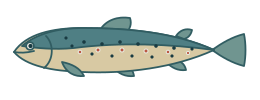
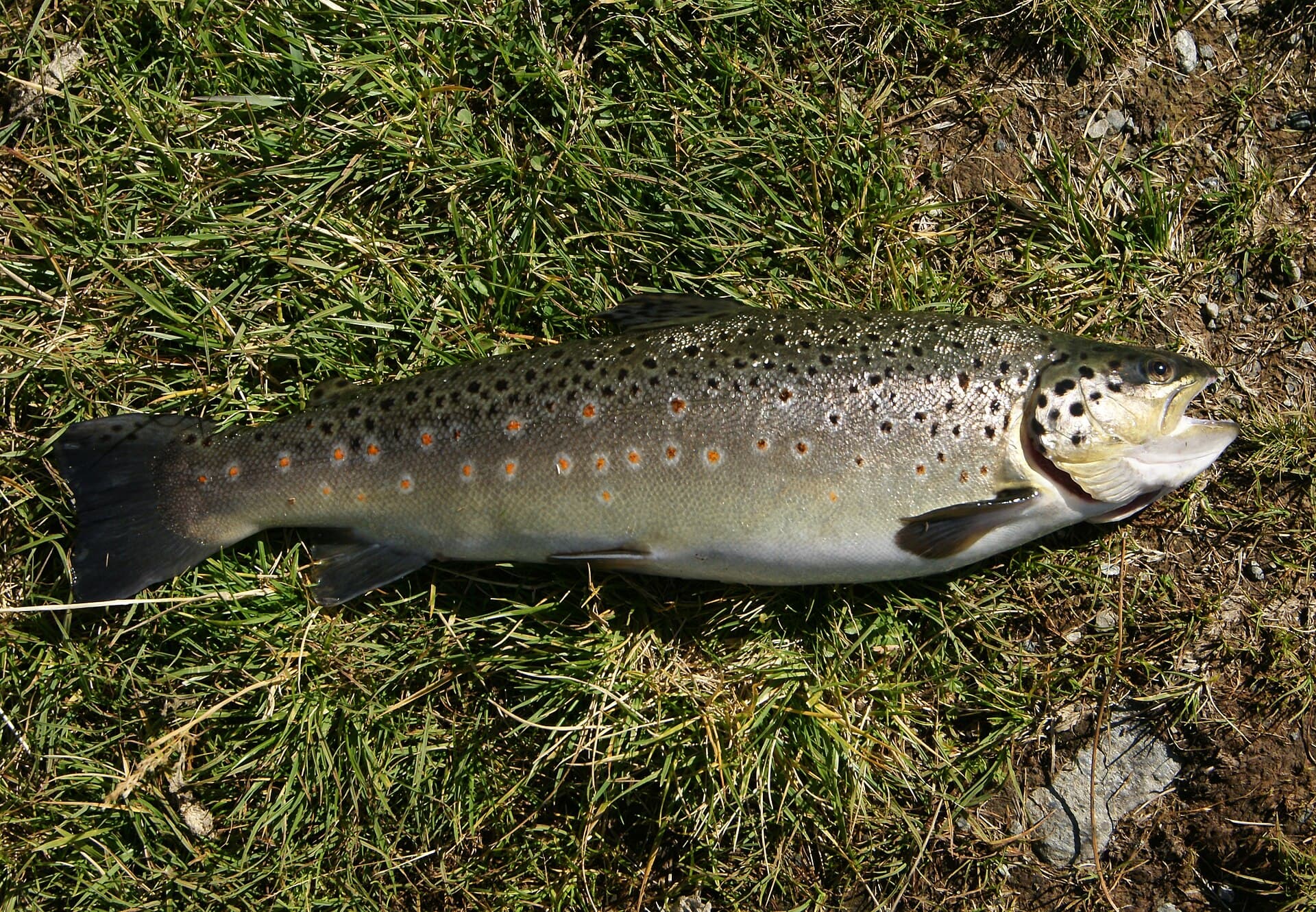
→Varies greatly in colour, size and shape, strongly depending on the environment it lives in.SourceFact from a specialist source · Applies to all regions1EncyclopediaStore norske leksikonørretAll sources on this page
→Trout in running water are usually fairly dark, with many black and red spots on the sides.SourceFact from a specialist source · Applies to all regions1EncyclopediaStore norske leksikonørretAll sources on this page
→Small trout differ from small salmon by a less forked tail fin, a longer upper jaw and a red edge at the back of the adipose fin.SourceFact from a specialist source · Applies to all regions1EncyclopediaStore norske leksikonørretAll sources on this page
Size
→Some large lakes hold big lake trout that can reach up to 20 kg, for example Mjøsa, Tyrifjorden and Randsfjorden.SourceFact from a specialist source · Applies to all regions1EncyclopediaStore norske leksikonørretAll sources on this page
→Stream trout live their whole lives in the stream and never grow large.SourceFact from a specialist source · Applies to all regions1EncyclopediaStore norske leksikonørretAll sources on this page
Diet
→Young trout eat mostly drifting insects, and as they grow larger also small fish. Big lake trout feed on fish.SourceFact from a specialist source · Applies to all regions1EncyclopediaStore norske leksikonørretAll sources on this page
Life history
→Usually spawns in rivers and streams, in gravel where the female digs a spawning pit (redd).SourceFact from a specialist source · Applies to all regions1EncyclopediaStore norske leksikonørretAll sources on this page
→When the young trout is 10–20 cm and 2–5 years old, it often migrates out into a lake or the sea, most often in spring.SourceFact from a specialist source · Applies to all regions1EncyclopediaStore norske leksikonørretAll sources on this page
→Found high in the mountains, up to 1400 metres above sea level or more.SourceFact from a specialist source · Applies to all regions1EncyclopediaStore norske leksikonørretAll sources on this page
The stock
→Many big lake trout strains are severely threatened by, among other things, river regulation, acid rain and overfishing.SourceFact from a specialist source · Applies to all regions1EncyclopediaStore norske leksikonørretAll sources on this page
Experiences
Tips from people who have fished for brown trout
From other anglers
Loading tips …
Experiences from readers. They have been read through, but not checked against sources, and do not count towards the source requirement. You will find rules only in the rules section. Tips are shown in the language they were written in, usually Norwegian.
Share an experience
Have you caught brown trout? Tell us what worked for you.
Sources
What this page is based on
The numbers in the text refer to the sources below. Fishing tips must be confirmed by at least three independent sources. Read about our source requirements.