Brosme brosmeSourceFact from a specialist source · Applies to all regions1ResearchHavforskningsinstituttetBrosmeAll sources on this page
Tusk is a bottom-dwelling deep-water fish that prefers rocky bottom.SourceFact from a specialist source · Applies to all regions1ResearchHavforskningsinstituttetBrosmeAll sources on this page
Southern and Eastern Norway: rare. Rare in the Skagerrak.SourceFact from a specialist source · Applies to all regions2EncyclopediaStore norske leksikonbrosmeAll sources on this page
Western Norway: present.SourcesFact from a specialist source · Applies to all regions1ResearchHavforskningsinstituttetBrosme2EncyclopediaStore norske leksikonbrosmeAll sources on this page
Central Norway: present.SourcesFact from a specialist source · Applies to all regions1ResearchHavforskningsinstituttetBrosme2EncyclopediaStore norske leksikonbrosmeAll sources on this page
Northern Norway: present.SourcesFact from a specialist source · Applies to all regions1ResearchHavforskningsinstituttetBrosme2EncyclopediaStore norske leksikonbrosmeAll sources on this page
Found in
Bottom
Best season
Jan–Dec
Methods
Bait on the bottom
Rules checked
29 September 2026
Getting started
Your first try for tusk
One recommended starting point: bait on the bottom from a boat. More methods are listed under “How to fish”.
A rod with a strong butt and a slightly softer tip, and a heavy-duty reel with a low gear ratio that holds 500 metres of braided line of 0.32–0.39 mm.SourceTackle advice from a source of experience · Applies to all regions3ExperienceHooked.noSlik fisker du brosmeAll sources on this page
→The sinker hangs at the bottom and the hooks with bait on short droppers just above, so the bait lies on or just above the bottom.SourceTackle advice from a source of experience · Applies to all regions5Experienceasgeiralvestad.noSlik fisker du torsk, tips og triksAll sources on this page
→Attach the sinker with a slightly thinner line. If it gets stuck, only the sinker breaks off, and you save the rest of the rig.SourceTackle advice from a source of experience · Applies to all regions5Experienceasgeiralvestad.noSlik fisker du torsk, tips og triksAll sources on this page
Rare in the Skagerrak.SourceFact from a specialist source · Applies to all regions2EncyclopediaStore norske leksikonbrosmeAll sources on this page
Western NorwayPresent
Rogaland and Vestland, south of StadSourcesFact from a specialist source · Applies to all regions1ResearchHavforskningsinstituttetBrosme2EncyclopediaStore norske leksikonbrosmeAll sources on this page
Central NorwayPresent
Møre og Romsdal and TrøndelagSourcesFact from a specialist source · Applies to all regions1ResearchHavforskningsinstituttetBrosme2EncyclopediaStore norske leksikonbrosmeAll sources on this page
Northern NorwayPresent
Nordland, Troms and FinnmarkSourcesFact from a specialist source · Applies to all regions1ResearchHavforskningsinstituttetBrosme2EncyclopediaStore norske leksikonbrosmeAll sources on this page
A rod with a strong butt and a slightly softer tip, and a heavy-duty reel with a low gear ratio that holds 500 metres of braided line of 0.32–0.39 mm.SourceTackle advice from a source of experience · Applies to all regions3ExperienceHooked.noSlik fisker du brosmeAll sources on this page
The assessment covers the coast as a whole. The season can vary locally, and closed seasons may stop the fishing. See the rules further down.
Time of day
The time of day is not documented well enough to give advice.
→Tusk spawn in April–June.SourcesFact from a specialist source · Applies to all regions1ResearchHavforskningsinstituttetBrosme2EncyclopediaStore norske leksikonbrosmeAll sources on this page
Rules
Minimum sizes and closed seasons
Show rules for
Showing rules for the whole coast. Rules that apply to only part of the coast are labelled.Showing rules for Southern and Eastern Norway (Østfold to Agder (the Skagerrak coast)).Showing rules for Western Norway (Rogaland and Vestland, south of Stad).Showing rules for Central Norway (Møre og Romsdal and Trøndelag).Showing rules for Northern Norway (Nordland, Troms and Finnmark).
→The Directorate of Fisheries states that there is no minimum size for tusk.SourceRule from the authorities · Applies to all regions9AuthorityFiskeridirektoratetMinstemål i fritidsfiskeAll sources on this page
→Tusk is not on the Directorate of Fisheries’ overview of protected and partially protected species.SourceRule from the authorities · Applies to all regions10AuthorityFiskeridirektoratetFreda og delvis freda artarAll sources on this page
→It is prohibited to fish closer than 100 metres to fish farms.SourceRule from the authorities · Applies to all regions15AuthorityFiskeridirektoratetGenerelle reglarAll sources on this page
→It is not permitted to use live fish or other live animals as bait.SourceRule from the authorities · Applies to all regions15AuthorityFiskeridirektoratetGenerelle reglarAll sources on this page
→Northern NorwaySeparate local restrictions may apply, for example for the cod fishery in Lofoten.SourceRule from the authorities · Applies to: Northern Norway15AuthorityFiskeridirektoratetGenerelle reglarAll sources on this page
The rules are translated from Norwegian. Only the Norwegian text and the authorities’ own pages (in Norwegian) are authoritative. Check them before your trip.
Not checked: rules in national parks and other protected areas at sea and local rules adopted by the municipality. The regulations may change, so always check the current rules before your trip.
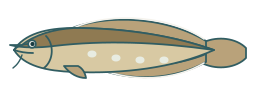
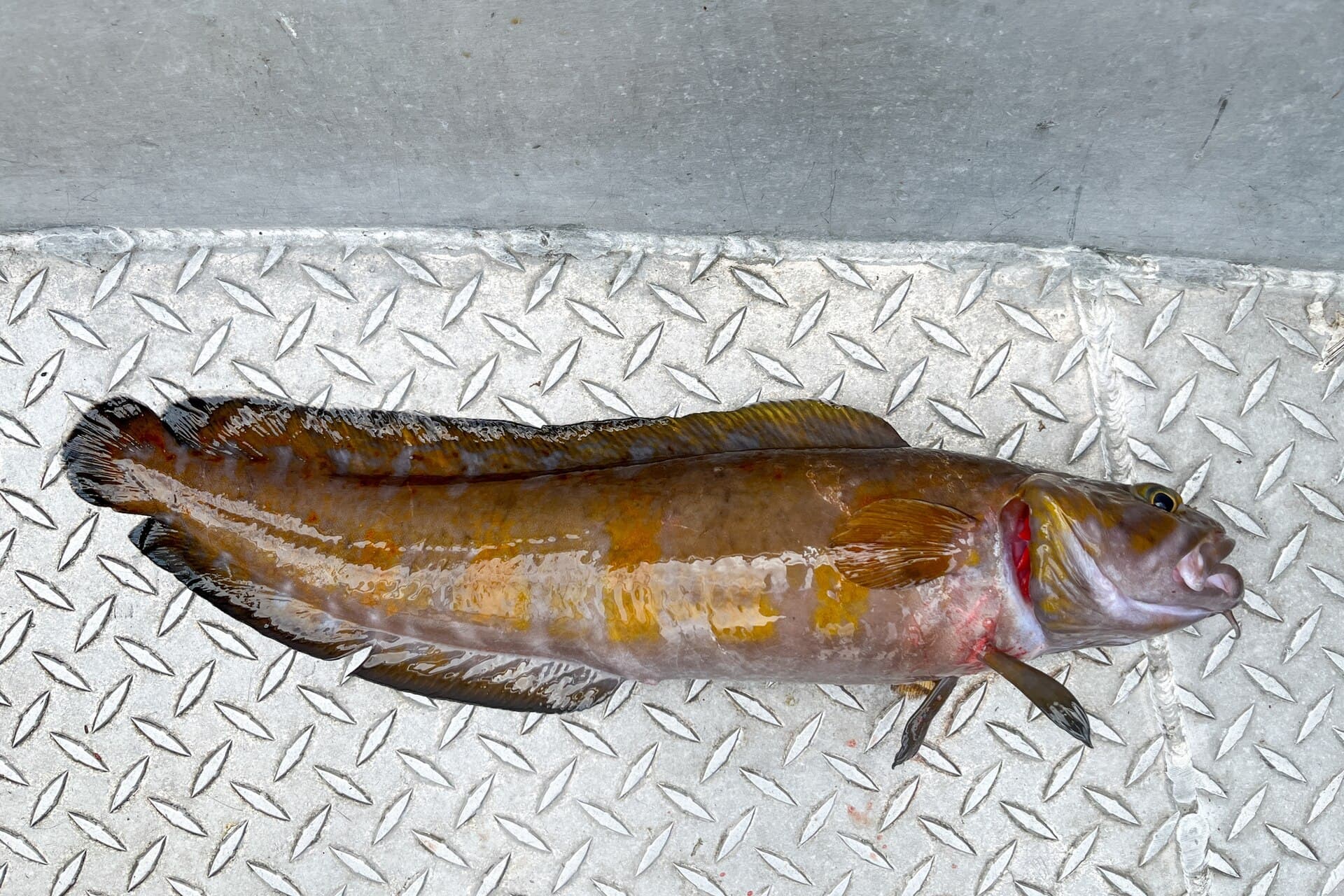
→Only one long dorsal fin. All other Norwegian species in the same family have two or three dorsal fins. Has one barbel under the chin.SourceFact from a specialist source · Applies to all regions2EncyclopediaStore norske leksikonbrosmeAll sources on this page
→The dorsal fin, tail fin and anal fin are edged with a white band on the outside and a black band inside it. Older fish have no spots, while younger ones have 5–6 indistinct pale spots or stripes on each side.SourceFact from a specialist source · Applies to all regions2EncyclopediaStore norske leksikonbrosmeAll sources on this page
→The body is elongated, with a light grey or brownish back and sides and a greyish-white belly.SourceFact from a specialist source · Applies to all regions2EncyclopediaStore norske leksikonbrosmeAll sources on this page
Size
→Can reach about 1 metre and 15 kg.SourcesFact from a specialist source · Applies to all regions1ResearchHavforskningsinstituttetBrosme2EncyclopediaStore norske leksikonbrosmeAll sources on this page
Diet
→Fish and crustaceans such as Norway lobster, squat lobster and shrimp.SourcesFact from a specialist source · Applies to all regions1ResearchHavforskningsinstituttetBrosme2EncyclopediaStore norske leksikonbrosmeAll sources on this page
Life history
→Bottom-dwelling and prefers rocky bottom. Adults live in relatively deep water, but juveniles can be found quite shallow.SourceFact from a specialist source · Applies to all regions1ResearchHavforskningsinstituttetBrosmeAll sources on this page
→Stays mostly at 100–1000 metres depth.SourcesFact from a specialist source · Applies to all regions1ResearchHavforskningsinstituttetBrosme2EncyclopediaStore norske leksikonbrosmeAll sources on this page
→Spawns in April–June, among other places off the coast of Southern and Central Norway.SourcesFact from a specialist source · Applies to all regions1ResearchHavforskningsinstituttetBrosme2EncyclopediaStore norske leksikonbrosmeAll sources on this page
→Becomes sexually mature at 8–10 years of age and can probably live to over 20.SourceFact from a specialist source · Applies to all regions1ResearchHavforskningsinstituttetBrosmeAll sources on this page
→Found along the whole Norwegian coast, but rare in the Skagerrak and Kattegat.SourceFact from a specialist source · Applies to all regions2EncyclopediaStore norske leksikonbrosmeAll sources on this page
The stock
→Since 2010 landings of tusk in the North Atlantic have gone down, from almost 30,000 tonnes in 2010 to 19,000 tonnes in 2023.SourceFact from a specialist source · Applies to all regions1ResearchHavforskningsinstituttetBrosmeAll sources on this page
→Previously there was no quota regulation for Norwegian fishers in the Norwegian zone. From 2023 the Ministry of Trade, Industry and Fisheries has set regulation for fishing for tusk north of 62°N.SourceFact from a specialist source · Applies to all regions1ResearchHavforskningsinstituttetBrosmeAll sources on this page
Experiences
Tips from people who have fished for tusk
From other anglers
Loading tips …
Experiences from readers. They have been read through, but not checked against sources, and do not count towards the source requirement. You will find rules only in the rules section. Tips are shown in the language they were written in, usually Norwegian.
Share an experience
Have you caught tusk? Tell us what worked for you.
Sources
What this page is based on
The numbers in the text refer to the sources below. Fishing tips must be confirmed by at least three independent sources. Read about our source requirements.