Perca fluviatilisSourceFact from a specialist source · Applies to all regions1EncyclopediaStore norske leksikonabborAll sources on this page
Also called (Norwegian names)tryteskjebbeåborSourceFact from a specialist source · Applies to all regions1EncyclopediaStore norske leksikonabborAll sources on this page
Perch are very common in fresh water, and perch fishing is a popular pastime, both with a rod in summer and as ice fishing in winter.SourceFact from a specialist source · Applies to all regions1EncyclopediaStore norske leksikonabborAll sources on this page
Southern and Eastern Norway: common. Common in Southern and Eastern Norway.SourceFact from a specialist source · Applies to all regions1EncyclopediaStore norske leksikonabborAll sources on this page
Western Norway: rare. Absent along the coast from south-western Norway northwards.SourceFact from a specialist source · Applies to all regions1EncyclopediaStore norske leksikonabborAll sources on this page
Central Norway: present. Occurs more locally in Trøndelag.SourceFact from a specialist source · Applies to all regions1EncyclopediaStore norske leksikonabborAll sources on this page
Northern Norway: present. Occurs more locally in Nordland and Troms, but is common in Finnmark.SourceFact from a specialist source · Applies to all regions1EncyclopediaStore norske leksikonabborAll sources on this page
Found in
Bottom
Best season
Feb–Mar and Jun–Oct
Methods
Worm and float, Spinner, spoon and jig, Pimpel and mormyshka on the ice
Water
LakeSourceFact from a specialist source · Applies to all regions1EncyclopediaStore norske leksikonabborAll sources on this page
Getting started
Your first try for perch
One recommended starting point: worm and float from shore or from a boat. More methods are listed under “How to fish”.
A sensitive float, preferably a slim antenna float, instead of the classic red-and-white one.SourceTackle advice from a source of experience · Applies to all regions6ExperienceHooked.noMeite etter abborAll sources on this page
Hook
Match the size to the fish: small fish, small hook and small worm.SourceTackle advice from a source of experience · Applies to all regions7ExperienceHooked.noAbbor (Fiskepedia)All sources on this page
Bait
Earthworms or maggots. Dew worms (lobworms) may be the very best.SourceTackle advice from a source of experience · Applies to all regions6ExperienceHooked.noMeite etter abborAll sources on this page
2Float. Shows when the fish bites. The float must match the weight hanging below it, otherwise it sinks or shows the bites poorly.SourceTackle advice from a source of experience · Applies to all regions8ExperienceFiske365Hvordan fiske med duppAll sources on this page
3Split shot. Small split shot pinched onto the line between the float and the hook.SourceTackle advice from a source of experience · Applies to all regions6ExperienceHooked.noMeite etter abborAll sources on this page
4Hook with bait. A small hook and a small worm for small fish.SourceTackle advice from a source of experience · Applies to all regions7ExperienceHooked.noAbbor (Fiskepedia)All sources on this page
How to assemble it
→Attach the float to the line. The length from the float down to the hook decides how deep the bait goes.SourceTackle advice from a source of experience · Applies to all regions8ExperienceFiske365Hvordan fiske med duppAll sources on this page
→Pinch on split shot until only the tip of the float is visible. The fish then feels as little resistance as possible, and you see the bites better.SourceTackle advice from a source of experience · Applies to all regions6ExperienceHooked.noMeite etter abborAll sources on this page
→Thread the worm onto the hook so that it hides the hook as well as possible.SourceTackle advice from a source of experience · Applies to all regions8ExperienceFiske365Hvordan fiske med duppAll sources on this page
4. How to do it
→Worm and float is a classic and simple method for perch.SourceFishing tip from a specialist source · Applies to all regions1EncyclopediaStore norske leksikonabborAll sources on this page
→Weight the float down so that only the tip shows. The perch then feels minimal resistance, and you see the bites better.SourceTackle advice from a source of experience · Applies to all regions6ExperienceHooked.noMeite etter abborAll sources on this page
Common in Southern and Eastern Norway.SourceFact from a specialist source · Applies to all regions1EncyclopediaStore norske leksikonabborAll sources on this page
Western NorwayRare
Absent along the coast from south-western Norway northwards.SourceFact from a specialist source · Applies to all regions1EncyclopediaStore norske leksikonabborAll sources on this page
Central NorwayPresent
Occurs more locally in Trøndelag.SourceFact from a specialist source · Applies to all regions1EncyclopediaStore norske leksikonabborAll sources on this page
Northern NorwayPresent
Occurs more locally in Nordland and Troms, but is common in Finnmark.SourceFact from a specialist source · Applies to all regions1EncyclopediaStore norske leksikonabborAll sources on this page
Technique and tackle
How to fish for perch
From shoreFrom boat
Worm and float
→Worm and float is a classic and simple method for perch.SourceFishing tip from a specialist source · Applies to all regions1EncyclopediaStore norske leksikonabborAll sources on this page
→Weight the float down so that only the tip shows. The perch then feels minimal resistance, and you see the bites better.SourceTackle advice from a source of experience · Applies to all regions6ExperienceHooked.noMeite etter abborAll sources on this page
Float
A sensitive float, preferably a slim antenna float, instead of the classic red-and-white one.SourceTackle advice from a source of experience · Applies to all regions6ExperienceHooked.noMeite etter abborAll sources on this page
Hook
Match the size to the fish: small fish, small hook and small worm.SourceTackle advice from a source of experience · Applies to all regions7ExperienceHooked.noAbbor (Fiskepedia)All sources on this page
Bait
Earthworms or maggots. Dew worms (lobworms) may be the very best.SourceTackle advice from a source of experience · Applies to all regions6ExperienceHooked.noMeite etter abborAll sources on this page
From shoreFrom boat
Spinner, spoon and jig
→Perch are caught on casting lures such as spinners, spoons and crankbaits (wobblers).SourceFishing tip from a specialist source · Applies to all regions1EncyclopediaStore norske leksikonabborAll sources on this page
A light spinning rod with a casting weight of around 15–25 grams and thin braided line.SourceTackle advice from a source of experience · Applies to all regions12ExperienceSvenskt FiskeAbborrfiske – lär dig grundernaAll sources on this page
Lures
Spinners and jigs of 5–10 cm are a good starting point.SourceTackle advice from a source of experience · Applies to all regions2OrganisationNorges Jeger- og FiskerforbundAbborAll sources on this page
Two short ice rods, one rigged with a pimpel and one with a mormyshka.SourceTackle advice from a source of experience · Applies to all regions3ExperienceHooked.noHvordan fiske abbor på isen?All sources on this page
Bait
White maggots on the pimpel and red bloodworms on the mormyshka.SourceTackle advice from a source of experience · Applies to all regions3ExperienceHooked.noHvordan fiske abbor på isen?All sources on this page
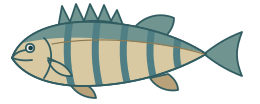
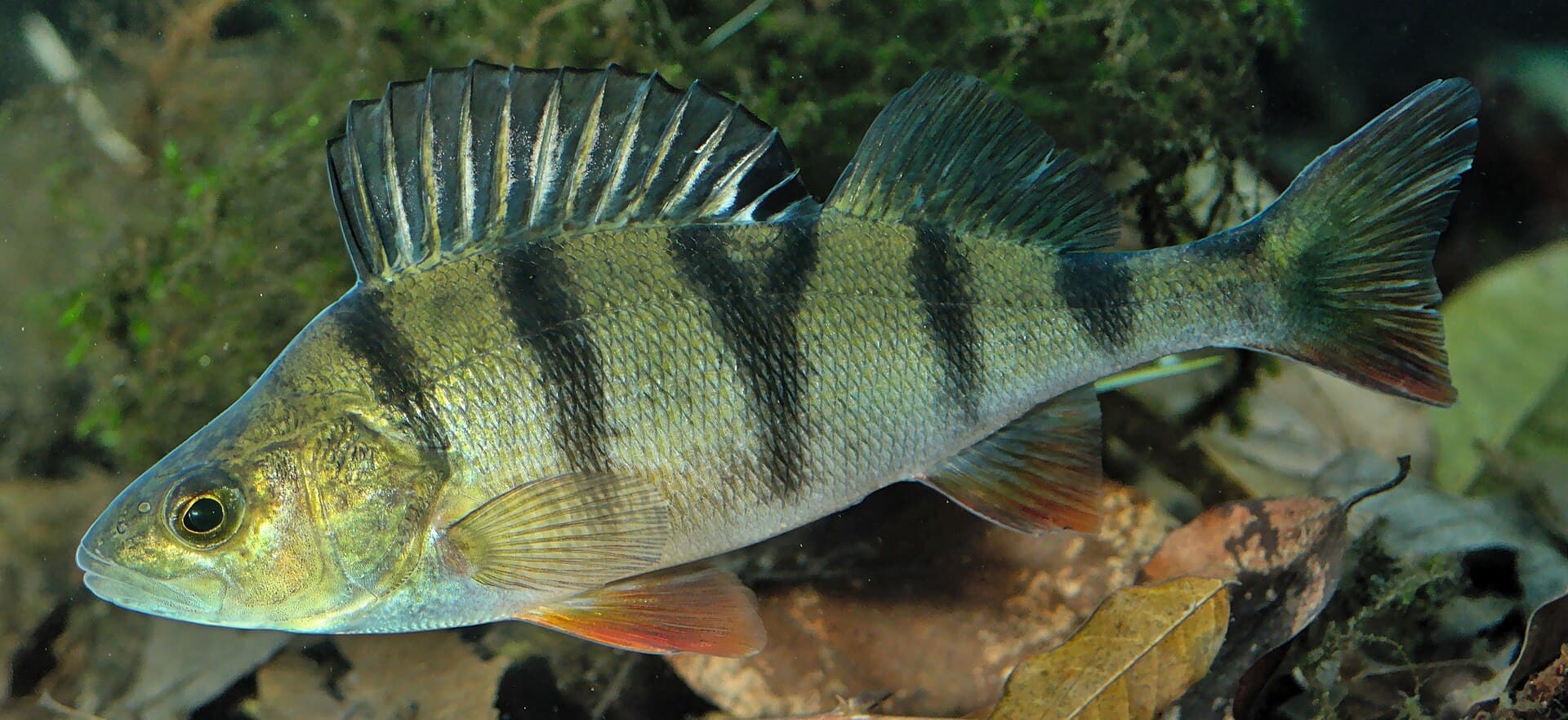
→Easy to recognise by its two dorsal fins. The whole of the front dorsal fin has strong spiny rays.SourceFact from a specialist source · Applies to all regions1EncyclopediaStore norske leksikonabborAll sources on this page
→Usually has 5–6 dark vertical bars on the side of the body, yellowish pectoral fins and reddish pelvic fins. The base colour is green or brown and varies greatly with the habitat.SourceFact from a specialist source · Applies to all regions1EncyclopediaStore norske leksikonabborAll sources on this page
Size
→In small lakes and ponds where perch are the only fish species, they rarely grow larger than 13–14 cm. Such populations are often called “tusenbrødre” (“thousand brothers”).SourceFact from a specialist source · Applies to all regions1EncyclopediaStore norske leksikonabborAll sources on this page
→Where it lives alongside other species and can hunt small fish, it grows faster and can reach 2 kg in favourable conditions. In very rare cases it grows to over 50 cm and 4 kg.SourceFact from a specialist source · Applies to all regions1EncyclopediaStore norske leksikonabborAll sources on this page
→The females grow considerably larger than the males.SourceFact from a specialist source · Applies to all regions1EncyclopediaStore norske leksikonabborAll sources on this page
Diet
→Lives first on zooplankton and then on bottom-dwelling animals, especially insect larvae, near the shore. Large perch are predators and often cannibals.SourceFact from a specialist source · Applies to all regions1EncyclopediaStore norske leksikonabborAll sources on this page
Life history
→Spawns early in spring, just after the ice breaks up, in shallow water. The eggs lie in a jelly-like string that is attached to aquatic plants and twigs.SourceFact from a specialist source · Applies to all regions1EncyclopediaStore norske leksikonabborAll sources on this page
→Younger perch often form small schools that actively search for food. Larger perch tend to appear alone or in smaller groups.SourceFact from a specialist source · Applies to all regions1EncyclopediaStore norske leksikonabborAll sources on this page
→Found in very many kinds of lakes and watercourses and tolerates large variations in water quality. It is often the only fish species in small forest ponds.SourceFact from a specialist source · Applies to all regions1EncyclopediaStore norske leksikonabborAll sources on this page
The stock
→The perch is assessed as Least Concern (LC) on the Norwegian Red List.SourceFact from a specialist source · Applies to all regions1EncyclopediaStore norske leksikonabborAll sources on this page
→Perch have been released into many lakes they have not reached on their own. The Norwegian Biodiversity Information Centre (Artsdatabanken) has therefore classified them as a regionally alien species, with a very high risk of negative ecological effects where they are introduced.SourceFact from a specialist source · Applies to all regions1EncyclopediaStore norske leksikonabborAll sources on this page
Experiences
Tips from people who have fished for perch
From other anglers
Loading tips …
Experiences from readers. They have been read through, but not checked against sources, and do not count towards the source requirement. You will find rules only in the rules section. Tips are shown in the language they were written in, usually Norwegian.
Share an experience
Have you caught perch? Tell us what worked for you.
Sources
What this page is based on
The numbers in the text refer to the sources below. Fishing tips must be confirmed by at least three independent sources. Read about our source requirements.